Key Takeaways
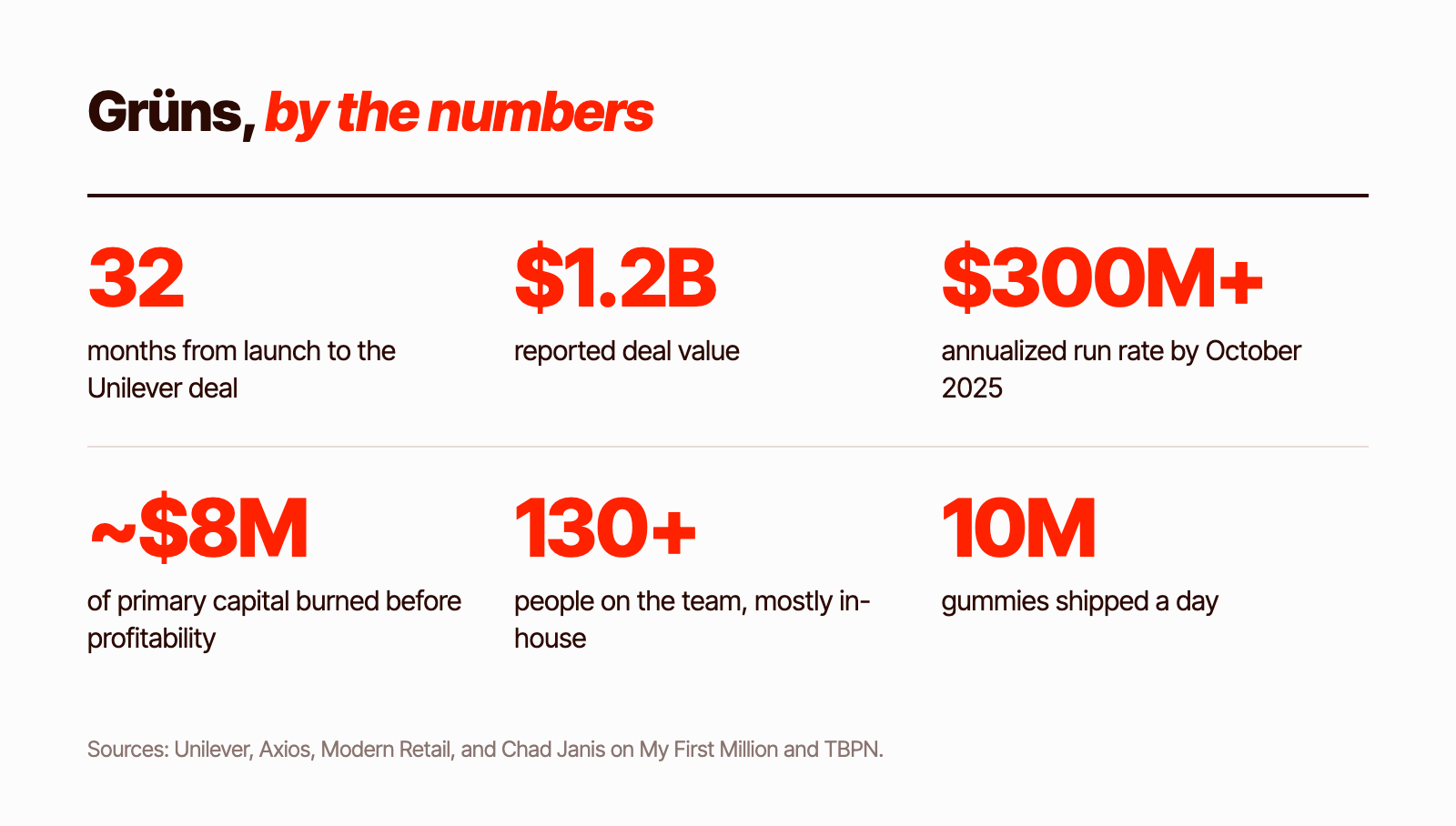
- Grüns launched in August 2023 and agreed to sell to Unilever in April 2026, at a value Axios reported at about $1.2 billion. By late 2025 it was doing over $300 million in annualized revenue.
- The core bet wasn't an ingredient. It was a format: comprehensive nutrition in a daily pack of gummies people actually look forward to.
- Every person at the company knew one number, the CAC ceiling, set to keep lifetime value at 3x acquisition cost or better. Growth was whatever that ceiling allowed.
- On creative, Grüns tested hundreds of ads a month, found angles that worked, then built the entire funnel around each winner. It led with fun, not fear or clinical claims.
- It never treated Meta as the whole plan. Amazon, retail and other channels came early, and operations kept up with demand.
In August 2023, a Stanford MBA student started selling a greens supplement in gummy form. Thirty-two months later, one of the world's biggest consumer goods companies agreed to buy it.
On April 9, 2026, Unilever announced it would acquire Grüns. Terms weren't disclosed, but Axios reported the deal valued Grüns at around $1.2 billion. It closed on June 1.
For anyone running paid media for a consumer brand, it's one of the most useful case studies of the last decade. Not because Grüns found a trick, but because founder Chad Janis has been unusually open about how the machine works.
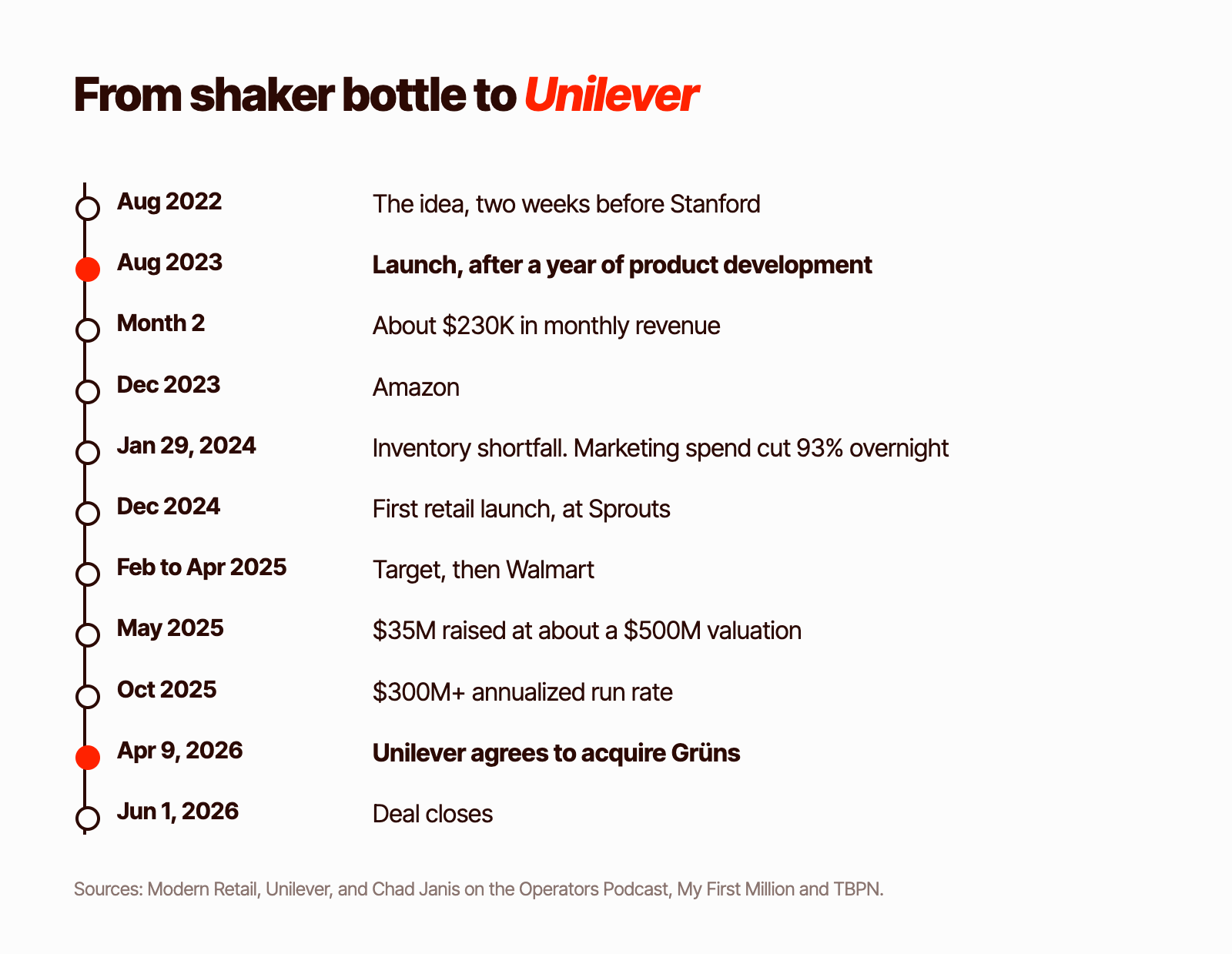
The Grüns Timeline
| Date | Milestone |
|---|---|
| August 2022 | Janis has the idea, two weeks before starting at Stanford |
| August 2023 | Launches online after about a year of product development |
| Month 2 | About $230,000 in monthly revenue, per Janis |
| December 2023 / January 2024 | Launches on Amazon |
| December 2024 | First retail launch, at Sprouts |
| February 2025 | Target |
| April 2025 | Walmart |
| May 2025 | Raises $35 million at about a $500 million valuation |
| October 2025 | Over $300 million annualized run rate, per the company |
| April 9, 2026 | Unilever agrees to acquire Grüns |
| June 1, 2026 | Deal closes |
The retail and revenue milestones come from Modern Retail's timeline and its reporting on the company.
1. Start With a Habit Problem, Not an Ingredient
Janis came up through finance. He did M&A at Lazard, then spent three years at the growth equity firm Summit Partners investing in consumer brands, sitting in board meetings for companies like Dr. Squatch, Ruggable and Chubbies. By his count, he talked with hundreds of brands and saw the margin profiles and LTV to CAC curves of many of them.
But he's clear that Grüns didn't come from a spreadsheet. It came from a shaker bottle.
Two weeks before starting at Stanford, he was in his dad's office in Utah, drinking a greens powder. "There's no way I'm keeping this habit past 30 days," he told My First Million. It was gross, it was messy, and there was frothy sediment at the bottom.
The ads for greens powders all said it was delicious and easy. His experience said otherwise, and he figured he wasn't alone.
So he reframed the problem. Not "how do I make a better greens powder," but how do you take comprehensive nutrition and put it in "a format or some habit that people will look forward to and enjoy."
That framing matters for anyone making creative. Grüns wasn't selling ingredients. It was selling a habit people would actually keep. That's a very different brief.
2. New Formats Win
Janis puts it bluntly: "New formats win."
The gummy idea took him about a day. He'd been eating Sour Patch Kids every day since college. The bigger insight came within a week: the entire gummy vitamin category was built around 30 or 60 count bottles with a cap on top, one or two gummies per serving. You can't fit comprehensive nutrition into two gummies.
So Grüns put about eight gummies in a single daily pack. Every gummy is identical. Together they make up the full dose.
The catch was that nobody knew how to make it. Janis talked to about 50 co-manufacturers and packaging partners, and nearly every gummy maker told him it would taste disgusting. One agreed to try. Even then, the machinery to put sticky gummies into small packs didn't exist.
For roughly the first eight months, that co-manufacturer had about 20 people with gloves standing around a table, putting eight gummies into each sachet and sealing them by hand. Grüns later helped pioneer the machinery, and by 2026 it was shipping about 10 million gummies a day, according to Janis.
He also spent a year developing the product before launch, testing more than the formula: gummy shape, size, color, smell, taste and how many gummies per pack. Early samples went to about a quarter to half of his Stanford class, a deliberately diverse group outside the DTC bubble. "The product you see today is highly intentional," he said.
His advice to founders follows from that. Making a better version of an existing product might get you some success, but in his view it won't get you acquired. "Good product equals new white space."
What this means for creative
A new format is a gift to an ad account. It's visually distinct, easy to demo and instantly recognizable in a feed. Grüns protected that: Janis says when other brands put gummies in sachets, people ask why they're copying Grüns. "We want any business that takes that new format, we want to own it."
3. Set One CAC Ceiling and Make Everyone Know It
If there's one operating principle Janis repeats in every interview, it's this one.
"You could ask anybody at Grüns what our CAC ceiling is and they would know," he said on the Operators Podcast. From the customer service team to the CMO, everyone knew the maximum the company would pay to acquire a customer.
The ceiling was built to keep lifetime value at 3x customer acquisition cost or better. And Janis is specific about how he measures it:
- LTV is gross profit, not revenue. Fully burdened: after product costs, discounts, refunds, fulfillment, shipping and payment processing fees.
- It's measured over 36 months, with 3, 6 and 12 month checkpoints to adjust along the way.
- 3x is the floor, not the goal. He calls it table stakes for a business that wants to be acquired.
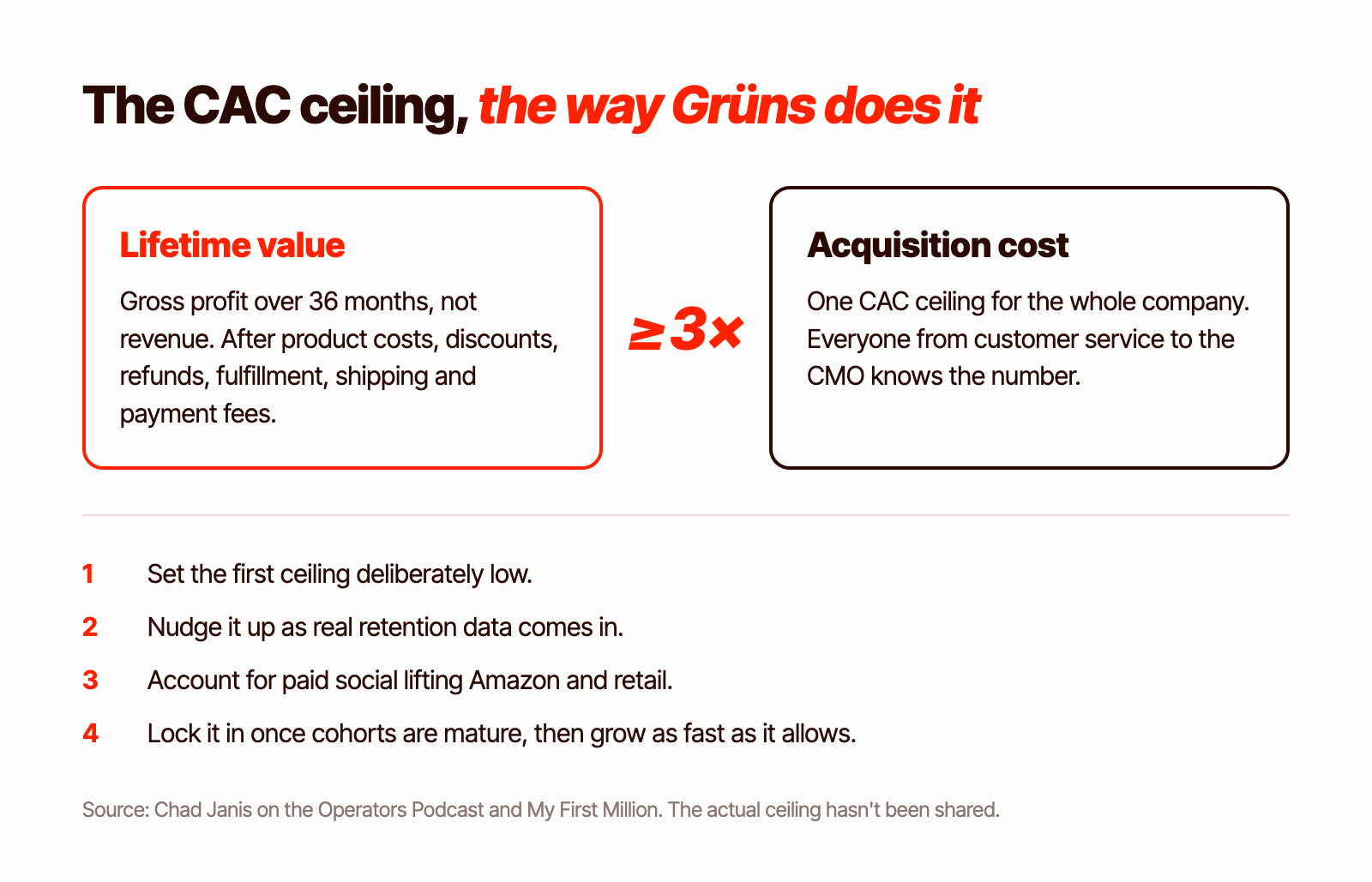
He set the first ceiling deliberately low. After month two's retention data came in, he nudged it up. When Grüns launched on Amazon, he raised it about 10% to account for paid social driving Amazon sales. By April 2024, with seven or eight months of cohort data, he set it properly and left it alone. Today it's about twice what it was on day one, he says, not because lifetime value magically improved, but because he started conservatively enough to be sure they'd hit it.
Growth Is an Output
The ceiling changes how you think about growth. "I'm gonna grow as fast as the world lets me at that CAC ceiling," Janis said. If the market offers a lot of customers at that cost in a given month, buy them. If it offers fewer, buy fewer.
"Our investor group isn't telling me to hit these targets," he said. "They mostly let us cook."
He contrasts that with brands that grew fast by buying lots of low-value customers, then fell off a cliff once they'd burned through their market. In supplements, he points out, you don't make money on the first order. "You got to make that money on the retention."
That discipline also kept capital needs low. Janis says Grüns burned about $8 million of primary capital before reaching profitability, and that it could have been less if they'd slowed growth.
4. Fun Beats Fear
Supplement advertising has a familiar playbook. Lead with a scary deficiency. Cite a clinical study. Imply the competition is worse.
Grüns went the other way. Its model was Dr. Squatch, which Janis watched up close at Summit. Squatch made showering fun and gave people a brand to relate to. Janis wanted to do the same for daily nutrition: "a lifestyle, something that people look forward to."
People buy Grüns, he says, because "it's fun for them. They get to share it with friends. Oh, by the way, it works."
That doesn't mean ignoring the science. Grüns runs clinical studies and tests its product well beyond what's required. It just doesn't lead with them. "We just don't talk about it because that's not fun," he said. On TBPN he added the other reason: that's what the rest of the category is doing.
The brand itself reflects that tone:
- The name. Grün is German for green. Janis, who speaks German from two years in Austria, Germany and Switzerland, liked that the umlaut looks like a smiley face. By his estimate about 70% of Americans mispronounce it. "I do not care how you pronounce our name as long as you're buying."
- Flavor drops. Grüns releases limited-time flavors every month or two, including a Grinch Punch flavor through a Dr. Seuss licensing deal and a strawberry vanilla collaboration with Olipop. Janis challenges anyone to name another supplement brand doing drops that make it fun to take the product every day.
- The original branding was made "in Canva in an afternoon," he admits. It got a proper rebrand when Grüns went to retail.
5. Test Angles at Volume, Then Build the Funnel Around Winners
This is the part most relevant to anyone running Meta ads, and Janis laid it out step by step on My First Million.
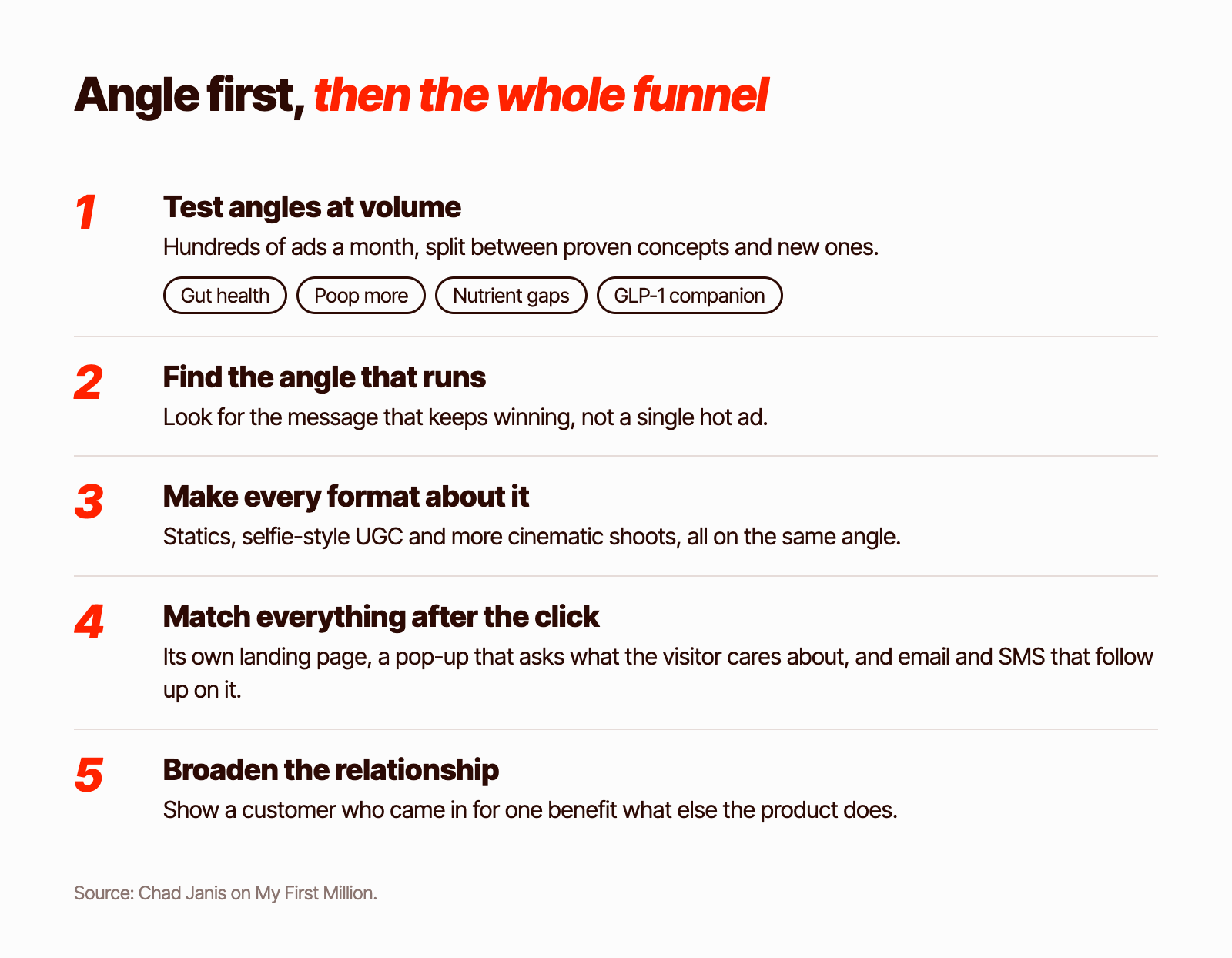
Step one: test in high volume. "You should test ads in high volume. So find new angles, test all over the place." Grüns was putting out "hundreds of ads a month, cycling in and out." That volume was split between business-as-usual concepts already known to work and new concepts looking for the next frontier.
Step two: build the funnel around what works. "Once you've identified an angle that seems to be running, then you build the entire funnel around it." That means statics, selfie-style UGC and more cinematic shoots, all aimed at the same angle.
Step three: match everything after the click. Each angle gets its own landing page. The pop-up asks what the visitor cares about, gut health for example, and the email and SMS that follow speak to that answer. Janis built the first landing pages himself in Replo, a Shopify page builder, and says a team can spin up "a completely new ad funnel" in a day from a template.
Step four: broaden the relationship. After purchase, the goal is to show someone who came in for one benefit that the product does more.
The Angles
Grüns' ads lean sassy and direct. Janis mentions a "poop more" angle, gut health and nutrient gaps. The most famous is how Grüns handled GLP-1 drugs. Other brands ran ads calling their products "nature's Ozempic," which Janis calls objectively wrong. Grüns instead positioned itself as the best friend to people on GLP-1s, a companion rather than a replacement.
It's a good example of what we'd call creative diversity: not 50 versions of one ad, but genuinely different messages for different buyers, each with its own path to purchase. More on that in what creative diversity on Meta actually means.
Made by People
On TBPN, Janis said Grüns' creative was still "99% plus" human-made: in-house editors, real people making UGC and influencers making content. He's cautious about AI-generated ads for a brand people need to trust.
Behind that, the marketing team was built like a production line. Janis described about three people on retention (email, SMS and flows), four to six creative strategists making ads, designers and video editors, four or five ad account managers analyzing what's working and feeding it back, and an ecommerce team testing landing pages, cart and checkout.
Integrity as Positioning
Janis says people sometimes call Grüns ads boring. His answer: "That's cuz we're like a reputable company that doesn't say we can cure cancer." Don't claim things your product doesn't do, he says, and do the science to back what you say.
And he's clear that ads alone weren't the secret. "It's not just like creating good ads. You got to have the good offer, good retention, a good product." Asked what separates average marketing from great marketing, his answer was simple: have a better product.
6. Don't Let Meta Be the Whole Plan
"Meta is always going to be a beast for like every brand that's online," Janis said on TBPN. It's the best place to find people in market. But he's surprised when brands run 85 to 90% of their mix on Meta. "You should probably diversify that a little bit."
Grüns diversified early:
- Amazon launched within months. Janis says Grüns' Amazon LTV to CAC was "phenomenal," much of it fueled by demand from paid social.
- Retail conversations started in January 2024, just months after launch. People told him it was too early. He knew retail sales cycles were long and the payoff would come a year later. "I just always knew this business was going to be omnichannel," he said.
- Other channels. Modern Retail reported Grüns used Meta, Google, YouTube, podcasts and influencers, and the brand's TV spots are logged on iSpot.
The logic ties back to the CAC ceiling. Grüns measured lifetime value to acquisition cost across DTC, Amazon and retail and kept the blended business at 3x or better. Paid social could run harder because some of its value showed up on Amazon and in stores.
7. Get to the Shelf Early, and Make the Shelf Easy
Grüns went from first retail conversation to Sprouts, Target and Walmart in about 15 months. It later added Sam's Club, Costco and Ulta, and was in more than 7,000 doors by spring 2026 according to reporting.
Two lessons stand out from how Janis talks about it:
- Packaging changes for retail. The rebrand was built so shoppers could identify the product in about three seconds on a shelf.
- Reliability is the product. At Walmart, the key metric is on-time, in-full delivery. Janis made 100% on-time, in-full Grüns' number one objective, and the company does its own demand forecasting for retailers.
He also points out that there's no prize for staying DTC-only. Meet customers where they shop, at the price that works for them.
8. Never Go Out of Stock
Janis calls operations "the part people are going to overlook."
The scariest moment came on January 29, 2024, about six months after launch. For two weeks the co-manufacturer had said inventory was fine. That day, it admitted it wasn't. Grüns cut its marketing spend 93% overnight.
It's the clearest example of how the company prioritized. "The golden rule at Grüns is we do not go out of stock," Janis said. "If that means we can't acquire customers, fine." When people take a product every day, running out breaks the habit you spent money creating.
The fix was planning capacity far ahead of demand. Janis says Grüns started onboarding new co-manufacturers six to nine months before it needed them, eventually running multiple co-manufacturers and co-packers, plus its own pack-out facility in Dallas, so each new partner only had to make gummies.
For anyone running ads, that's a sobering point. Great creative is worthless if the warehouse is empty, and an out-of-stock can force you to turn off the very ads that were working.
9. Build a Real Team
In early 2024, Janis was pitching investors that Grüns could reach $100 million in revenue with four employees. His chief of staff, Katie, told him a few months later that they needed to hire. She later became president.
By the time of the acquisition, Grüns had more than 130 people, mostly in-house. "No good brand, long-term long-standing brand is built off of five to 10 people," he said on the Operators Podcast. He judges efficiency by payroll plus agency fees as a share of revenue, not by headcount.
A few other choices stand out:
- A people leader early. Grüns hired a chief people officer unusually early, because "a company's success is the people."
- Everyone owns their domain. Janis wants every person to have the confidence to make decisions like a CEO, and sees his job as getting out of their way.
- AI where it actually helps. Grüns made its data warehouse accessible through AI to customer service, finance and marketing, and asked each person to list what in their role could be automated. Janis's description: they use AI "opportunistically, not existentially."
10. Raise Money Like You Might Not Need It
By Janis's recollection on the Operators Podcast, Grüns raised money roughly every six months: a small friends and family round, about $1.25 million just after launch, $6 million in early 2024, about $11 million in mid-2024, then $35 million in 2025 led by Headline at about a $500 million valuation. Janis says he deliberately took a valuation lower than he thought the business was worth to leave upside for the next investors.
His rule for fundraising: "If somebody wants to give you money, take it. Unless you're giving up voting control." The point wasn't to fund losses. By mid-2024 Grüns was around break-even, and the capital went to a cushion and to working capital for retail, which pays on long terms.
According to Forbes, Janis still owned about half the company when it sold.
Why Unilever
Unilever has a track record with this kind of brand. It bought Olly, the gummy vitamin brand Janis credits with making gummies mainstream, along with Liquid I.V., Nutrafol and Dr. Squatch. On TBPN, Janis said the first casual conversation with Unilever happened about ten months before the deal, and that fit with the people mattered most. He's staying on as CEO. "I'm not done here," he said on My First Million.
What CPG Brands Can Take From Grüns
Most brands can't invent a new format next quarter. But most of what made Grüns work is a set of decisions any brand spending real money on Meta can make:
- Sell the habit, not the ingredient. Ask what would make someone look forward to your product, then make ads about that.
- Know your CAC ceiling, and make sure everyone else does. Measure lifetime value as fully burdened gross profit, set the ceiling conservatively, and let growth be the output.
- Lead with fun and relatability. Keep the science as proof, not the pitch.
- Test angles at volume. Hundreds of ads a month isn't the point. Finding the next winning angle is.
- Build the whole funnel around each winner. Statics, UGC, landing page, pop-up, email and SMS should all tell the same story.
- Don't be 90% Meta. Use paid social to fuel Amazon, retail and other channels, and measure the blend.
- Protect the supply chain. Cutting spend because you ran out of product is the most expensive mistake in DTC.
- Stay honest. Claims you can't back eventually cost you more than they earn.
For more on making Meta creative for food, beverage and supplement brands, see the ultimate guide to making CPG Meta ad creative. For data on how many ads accounts like this actually run, see how many ads to run on Meta, and for more benchmarks, the Meta Ads Statistics hub.
If you want a team that tests angles and builds creative around what's working, that's what our CPG creative agency does. Book an intro call to talk through your account.
FAQ
How much did Unilever pay for Grüns?
Unilever didn't disclose terms. Axios reported the deal valued Grüns at around $1.2 billion. The acquisition was announced April 9, 2026, and closed June 1, 2026.
How long did it take Grüns to sell?
About 32 months from launch. Grüns started selling in August 2023 and agreed to the Unilever deal in April 2026.
How big was Grüns when it sold?
The company said it passed a $300 million annualized revenue run rate in October 2025. It had more than 130 employees and was in thousands of retail doors.
What is Grüns' CAC ceiling?
Janis hasn't shared the number. He has said the ceiling is set to keep lifetime value at 3x acquisition cost or better, with lifetime value measured as fully burdened gross profit over 36 months.
What channels did Grüns use?
Meta was the core paid channel, alongside Google, YouTube, podcasts, influencers and TV, according to Modern Retail and iSpot. Grüns launched on Amazon within months and moved into retail in late 2024.
What kind of ads did Grüns run?
Mostly human-made creative: UGC, statics and more produced shoots, tested at high volume. The angles were fun and direct, such as gut health and positioning Grüns as a companion for people on GLP-1 drugs, rather than fear-based or clinical claims.
Sources: Interviews with Chad Janis on the Operators Podcast (2025), My First Million (2026) and TBPN (2026). Deal and company facts from Unilever, Axios, Forbes and Modern Retail, linked above.