The Short Answer
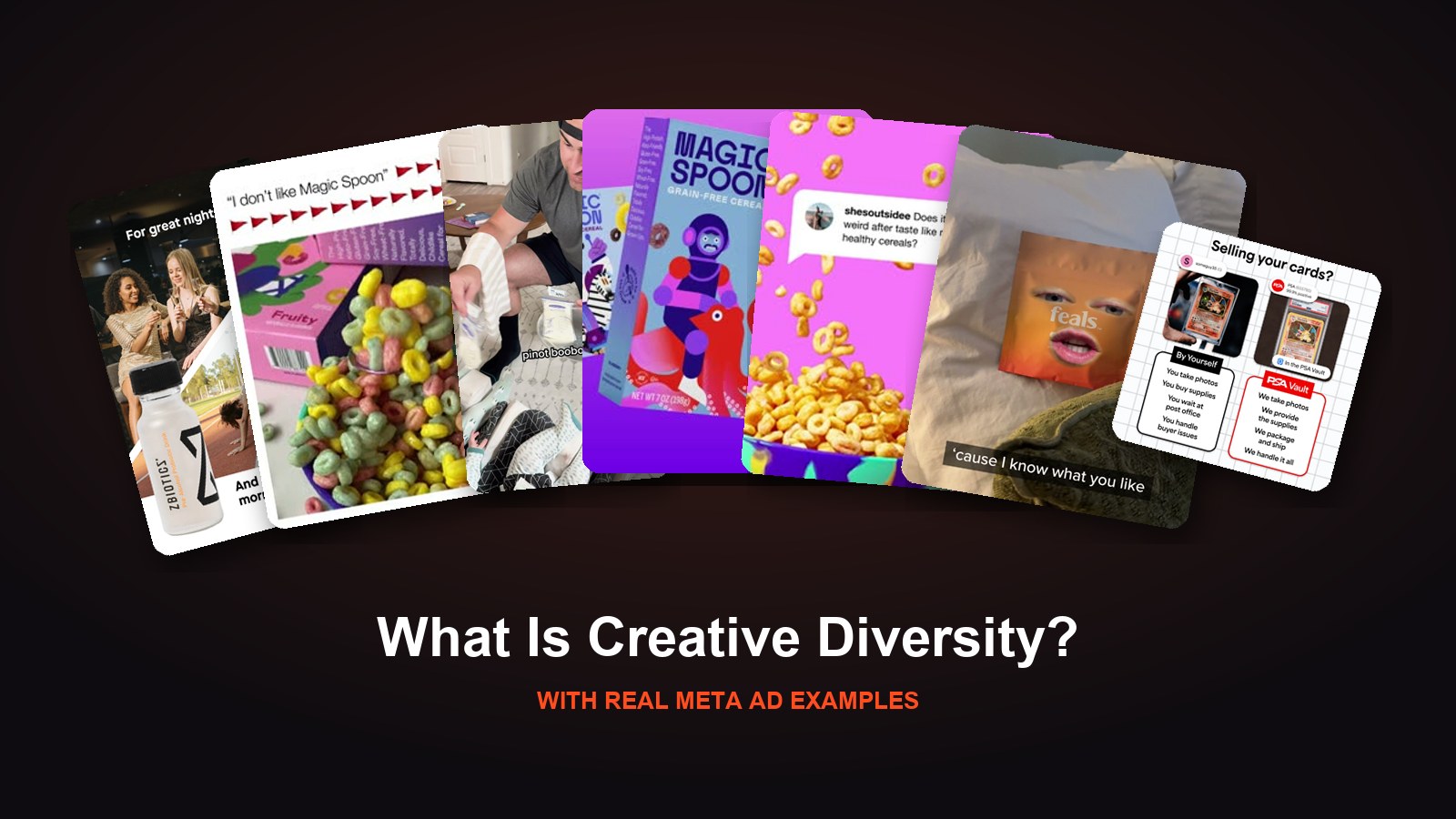
Creative diversity on Meta means running ads that are genuinely different from each other: different formats, messages, audiences, visual styles and hooks. It's not the same ad in five colors or the same script with a new headline. Diverse ads give Meta more distinct ways to reach different people. Near-identical ads mostly compete with each other for the same ones.
Why Creative Diversity Matters Now
Since Meta's Andromeda update, Meta decides who sees an ad largely based on the creative itself. The ad is the targeting. That changes what a good ad account looks like:
- Similar ads get treated as roughly the same ad. Ten versions of one idea reach roughly the same audience, so they don't add much reach.
- Different ads find different buyers. A comedy skit, a product demo and a customer review each appeal to a different kind of person, and Meta can route each one to the people most likely to respond.
- Winners are rare. Across the accounts we work with, a small share of ads (often 10–30%) drives most of the spend, which we broke down in our post on Meta account structure. More genuinely different concepts means more chances at the next big winner.
Diversity vs. Variation
The easiest way to understand creative diversity is to look at what isn't it.
These two Magic Spoon ads ran as part of a January push. Same concept (a protein-packed breakfast that simplifies your morning), same format, same look. Only the line and the scene change:
Magic Spoon: Skillet-free
Magic Spoon: No more dishes
That's a variation. Variations are useful for finding the best version of a concept that's already working. But to Meta, they're close to one idea.
Now compare three ads for the same Lansinoh brand:
Lansinoh: Breast milk sommelier skit
Lansinoh: First-time mom registry haul
Lansinoh: Pregnancy duo motion piece
A dad playing breast milk sommelier for his twins. A creator walking through her baby registry. A polished motion piece for a pregnancy skincare duo. Different format, different message, different product, different buyer. That's diversity: three separate ways for Meta to find a customer.
The 5 Dimensions of Creative Diversity
When we plan creative for an account, we look for range across five dimensions. An ad that differs on several of these counts as a new concept. An ad that differs on just one, like a new headline, usually counts as a variation.
1. Format
UGC, motion, statics, hybrids, skits, demos, memes. Each format catches a different kind of attention and a different mood in the feed. The Lansinoh ads above are a good example: a skit, a creator haul and a motion piece from the same brand. We make all of these in-house as a UGC, motion and static ad agency, because one format alone can't carry an account.
2. Message and angle
The reason someone should buy. For Magic Spoon, the same cereal was sold through completely different arguments:
Magic Spoon: Us vs. Them comparison
Magic Spoon: 40,000+ reviews
Magic Spoon: Customer service reply
A nutrition face-off against a typical fruity cereal. A review counter climbing past 40,000. And an objection-handling ad that answers real-looking comments like "it's so expensive for cereal." Each speaks to someone at a different stage: curious, skeptical or almost ready to buy.
3. Audience and persona
Who the ad is talking to. The same product can serve very different people, and the ad should show it:
Magic Spoon: Counting macros
Magic Spoon: Fuel your day
One is for someone counting macros who's tired of eggs and jerky. The other shows cereal in a peanut butter sandwich, a protein shake and a toddler's bowl, speaking to busy parents. Same product, two buyers who would never relate to each other's ad.
4. Visual style and polish
Polished and native both have a place. Some people respond to clean, branded motion. Others scroll right past anything that looks like an ad and stop for something that looks like a post.
Magic Spoon: The Waterfall
Magic Spoon: Red flag meme
The Waterfall is polished motion: boxes tumble down the screen while the stats land one at a time. The red flag meme is six seconds of "'I don't like Magic Spoon' 🚩🚩🚩" over a slow-motion spoonful. Both are Magic Spoon, and they look nothing alike.
5. Hook
The first second decides whether anyone sees the rest. Different hooks stop different people, even for the same product: a question ("1pm and already groggy?"), a bold claim, a surprising visual, a comparison or a relatable moment. Our static ad examples show a range of hooks that work even without motion.
A Creative Diversity Checklist
Before launching a new batch of ads, run through these questions:
- Format: Does this batch include more than one format (UGC, motion, static, hybrid)?
- Message: Are the ads making different arguments, or the same argument in different words?
- Audience: Is each ad clearly speaking to a specific type of buyer, and are those buyers different?
- Style: Is there a mix of polished and native-looking ads?
- Hook: Would the first second of each ad stop a different kind of person?
- People and settings: Are different creators, ages, places and situations on screen?
- The squint test: If you shrank all the ads to thumbnails, could you tell them apart?
If most ads in a batch would get the same answer on every question, you have variations, not diversity.
How Much Diversity Do You Need?
There's no exact number, but more distinct concepts gives Meta more to work with. As a starting point, we recommend 5–15 genuinely different ads per ad set, which we explain in how many ads per ad set on Meta. And keep adding new concepts regularly, because winners eventually fatigue. The easiest way to do that without disturbing what's working is to launch new concepts in their own ad set, which we cover in testing vs. scaling campaigns.
FAQ
What is creative diversity in Meta ads?
Running ads that are meaningfully different from each other in format, message, audience, visual style and hook, so Meta has distinct options to show different people. It's the opposite of running many small variations of one ad.
Why does Meta reward creative diversity?
Since the Andromeda update, Meta uses the creative itself to decide who sees an ad. Different ads reach different people, while similar ads compete for the same audience. More distinct creative gives Meta more ways to find buyers.
Is creative diversity the same as creative volume?
No. Fifty variations of one idea is volume, not diversity. Ten genuinely different concepts will usually give Meta more to work with than fifty near-identical ads.
Are variations bad?
No. Variations are useful for finding the best version of a concept that's already working. The problem is when an account is only variations of a few ideas.
How do I make my Meta ads more diverse?
Mix formats (UGC, motion, statics, hybrids), test different messages and angles, speak to different buyer types, balance polished and native styles, and try different hooks. Use the checklist above before each launch.
Built for Creative Diversity
Creative diversity is hard to sustain in-house. It takes different skills for UGC, motion and statics, plus a steady flow of new ideas every month. Biddyco is a creative agency for Meta ads for brands spending $100K–$5M+/month. Our in-house team makes UGC, motion, hybrid and static ads on a flat monthly retainer, built around giving Meta genuinely different concepts to scale. See more of our work in our DTC ad examples and 44 Magic Spoon ads.