The Short Answer
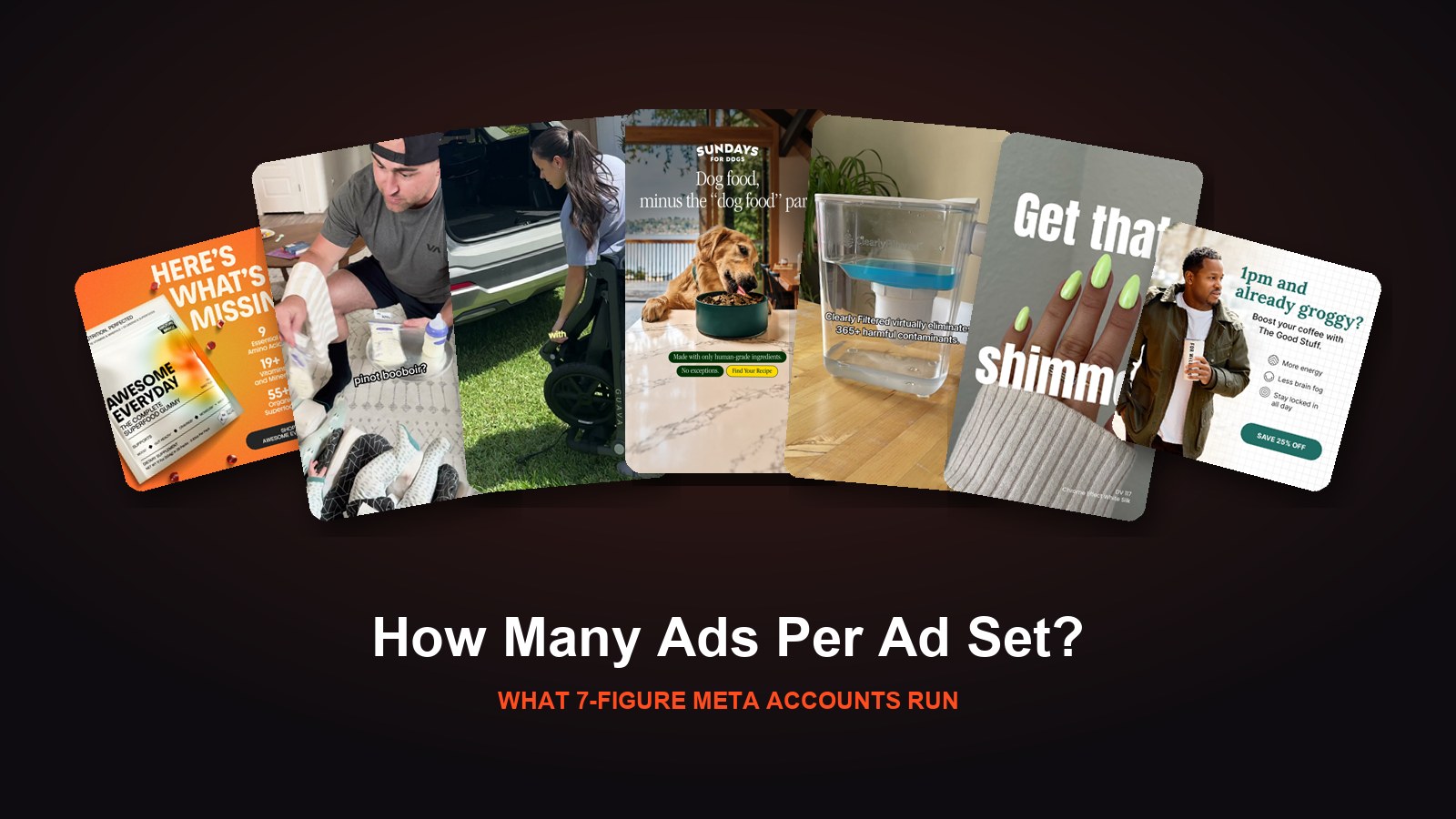
For most brands, 5–15 ads per ad set, and they should be genuinely different concepts, not variations of one idea. Meta lets you run up to 50 active ads in a single ad set, but you rarely need that many. You also need more than two or three if you want Meta to have real options.
What matters more than the number is how different the ads are. Ten ads that are all the same creator saying the same thing in different fonts count as roughly one concept to Meta. Ten ads that use different formats, hooks, messages and people give Meta ten real ways to find buyers.
That's the answer we give brands, and it comes from what we see across roughly a hundred ad accounts we make creative for, including a dozen spending over $1M a month.
What Real Accounts Run
We broke down three accounts spending $1M–$3M a month in our post on Meta account structure and creative testing. Here's how their ad sets compare:
| Account | Monthly spend | Structure | Ads per ad set | What's in each ad set |
|---|---|---|---|---|
| Account 1 | ~$3M | Multiple ad sets per campaign | 2–4 | One concept per ad set, with variations of it |
| Account 2 | ~$1M | 1 campaign, 3 ad sets | 10–30 | Distinct concepts |
| Account 3 | ~$1M | ~10 campaigns, 1 ad set each | 5–10 | Distinct concepts |
Three very different setups, all scaling to seven figures a month. So there's no single correct number. But two patterns hold across all of them:
- The ad set is either one concept or many distinct concepts. Account 1 puts one idea in each ad set and versions it. Accounts 2 and 3 put 5–30 genuinely different ideas side by side. None of them fill ad sets with near-duplicates of a few ideas.
- A small share of ads does most of the work. In every account, somewhere between 10% and 30% of ads drive 70–80% of spend. More ads doesn't mean more winners unless those ads are actually different.
Why the Number Matters Less Than Diversity
Since Meta's Andromeda update, Meta matches ads to people largely based on the creative itself. Ads that look and sound alike get treated as close to the same ad. So they compete with each other for the same audience instead of reaching new people.
That changes the question. It's less "how many ads should I have?" and more "how many different ideas does Meta have to work with?" A strong ad set usually mixes:
- Formats: UGC, motion, statics and hybrids
- Angles: a problem-solution ad, a comparison, social proof, an offer, a founder story
- People and settings: different creators, ages and situations, so the ad reaches different kinds of buyers
If you're not sure what "different" looks like in practice, our static ad examples and UGC ad examples show a range of concepts side by side.
When to Run Fewer Ads Per Ad Set
- Your budget is small. Every ad needs some spend to prove itself. On a smaller budget, 3–6 strong, different ads gives each one a fair shot, where 20 would spread spend too thin to learn anything.
- You're testing one concept. If the goal is to find the best version of one idea, like the Account 1 approach, 2–4 variations in a dedicated ad set keeps the read clean.
- You're still in the learning phase. Meta needs enough conversions per ad set to optimize, so it helps not to split a small budget across many ad sets and many ads at once.
When to Run More Ads Per Ad Set
- You're spending at scale. Higher budgets can support more ads, and more distinct concepts means more chances at an outlier. We've seen a single ad scale to roughly $500,000 a month in one account.
- You have a steady supply of new concepts. Accounts like Account 2 can run 10–30 ads per ad set because new, genuinely different creative keeps coming in.
- Ads are fatiguing fast. If performance drops quickly, adding fresh concepts, not more variations of tired ones, is usually the fix.
How to Tell If You Have Too Many (or Too Few)
- Too many: most ads in the ad set get almost no spend, and new ads never get a chance to deliver. Turn off ads that have had enough time and aren't getting spend, and add new concepts in batches.
- Too few: one or two ads take all the spend and fatigue quickly, and results slide every time they wear out. Add more distinct concepts before your winners run out of steam.
- Not diverse enough: you have plenty of ads, but they all look alike, and CPMs creep up while reach stalls. This is the most common problem we see, and it's a creative problem, not a structure problem.
FAQ
How many ads can you have in a Meta ad set?
Meta allows up to 50 active ads per ad set. Most accounts don't need anywhere near that. 5–15 distinct concepts is enough for most brands.
How many ads per ad set does Meta recommend?
Meta doesn't give one fixed number, and it encourages advertisers to use diverse creative so its system has more options. In our experience, 5–15 genuinely different ads per ad set is a strong default.
How many ad sets should I have per campaign?
There's no universal rule. The accounts above range from one ad set per campaign to several. At scale, fewer, larger ad sets with more creative diversity tend to be easier for Meta to optimize than many small ones.
Should each ad set test a different creative?
It depends on your approach. You can put one concept in each ad set and test variations of it, or put many distinct concepts in one ad set and let Meta choose. Both work at seven-figure spend. Just don't fill ad sets with near-identical ads.
How often should I add new ads?
Regularly. Accounts that scale add new concepts every week or every few weeks, because most ads underperform and winners eventually fatigue. The steadier your supply of new, different creative, the more chances you have at a breakout ad.
Need More Concepts, Not Just More Ads?
If your ad sets are full but everything looks the same, the fix is creative, not structure. Biddyco is a creative agency for Meta ads for brands spending $100K–$5M+/month. Our in-house team makes UGC, motion, hybrid and static ads on a flat monthly retainer, built to give Meta the range of concepts it takes to scale. See how our creative process works or what it costs to hire a creative agency.