Key Takeaways
- Three files cover almost every Meta placement: 4:5 for Feed, 9:16 for Stories and Reels, and 1:1 for carousel and the smaller placements.
- Meta now recommends 1440 pixels wide: 1440x1800, 1440x2560 and 1440x1440. The 1080 sizes still meet the minimums.
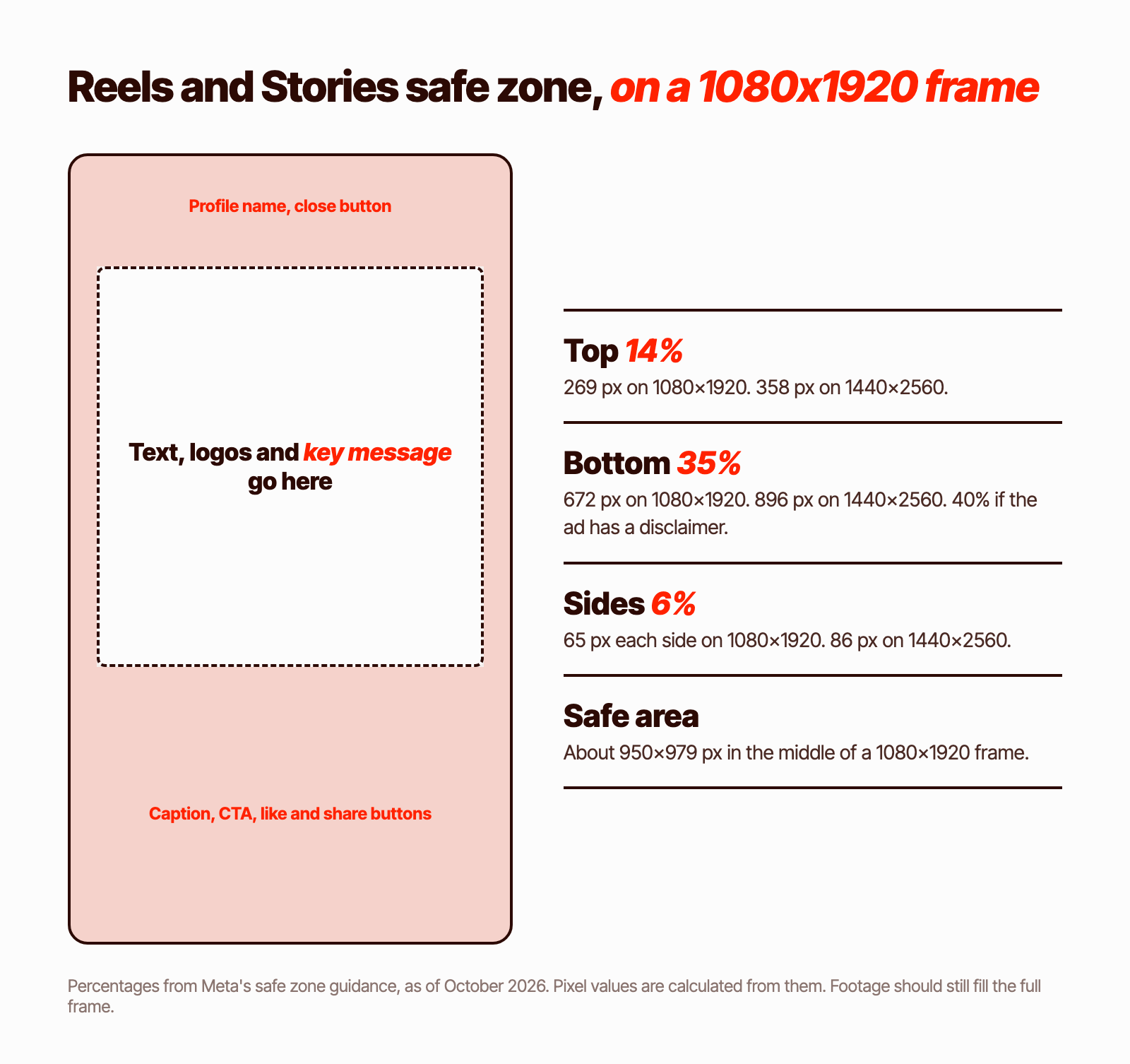
- On 9:16 ads, keep text and logos out of the top 14%, the bottom 35% and 6% on each side. On a 1080x1920 frame, that's 269 px, 672 px and 65 px.
- Text limits vary by placement. Write the point into the first 125 characters of primary text and a headline under 40.
- There's no 20% text rule anymore, but the safe zones still limit where text can go.
- The specs get your ad delivered. They don't make it good. That comes down to the creative.
Most Meta ads don't fail because of specs. But a lot of them run worse than they should because of specs.
A 1:1 video in Reels with a big empty band above and below it. A headline hidden behind the caption. A CTA that sits right where Instagram puts its like button. A logo cropped off the top of a Story.
Meta's specs live across dozens of Ads Guide and Help Center pages, and they don't always agree with each other. So we pulled them together. Below are the specs for every major Facebook and Instagram placement, taken from Meta's Ads Guide and Help Center as of October 2026. Meta updates these pages often, so check the source before a big launch.
The Short Version: Three Files That Cover Almost Everything
If you only make one set of files per concept, make these three.
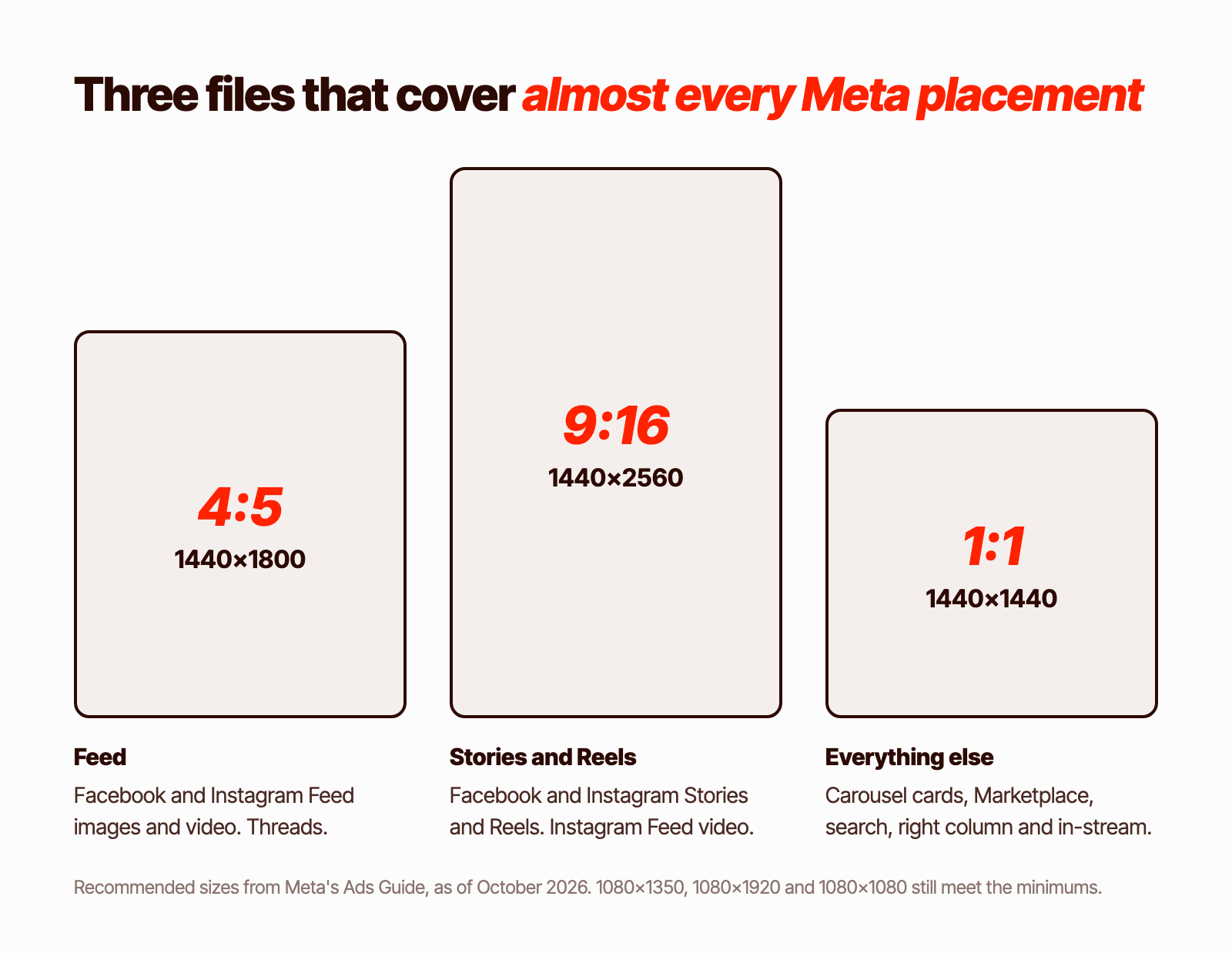
- 4:5 at 1440x1800. Facebook and Instagram Feed. Threads crops taller assets to 4:5 anyway.
- 9:16 at 1440x2560. Stories and Reels on Facebook and Instagram, and Instagram Feed video. Build it inside the safe zone.
- 1:1 at 1440x1440. Carousel cards, Marketplace, search results, the right column and in-stream video.
1080x1350, 1080x1920 and 1080x1080 still work. Meta lists 1080 as the recommended minimum and 1440 as the recommended size, so if you're exporting new files, export at 1440.
If you upload only one ratio, Ads Manager will crop, pad or expand it to fit other placements. That works, but you give up control over what gets cut. Upload the ratio each placement wants and you decide.
Meta Ad Specs by Placement
| Placement | Recommended ratio | Recommended size | Video length | Primary text / headline |
|---|---|---|---|---|
| Facebook Feed | 4:5 | 1440x1800 | 1 second to 241 minutes | 50 to 150 / 27 |
| Instagram Feed | 4:5 images, 9:16 video | 1440x1800 | 1 second to 60 minutes | 125 / 40 |
| Facebook Stories | 9:16 | 1440x2560 | 1 to 120 seconds | 125 / 40 |
| Instagram Stories | 9:16 | 1440x2560 | 1 second to 60 minutes | 125 |
| Facebook Reels | 9:16 | 1440x2560 | No maximum listed | 40 / 55 |
| Instagram Reels | 9:16 | 1440x2560 | Up to 15 minutes | 44 |
| Facebook Feed carousel | 1:1 | 1080x1080 minimum | 1 second to 240 minutes per card | 80 / 20 |
| Instagram Feed carousel | 1:1 (4:5 for image-only) | 1080x1080 minimum | 1 second to 2 minutes per card | 125 |
| Threads | 1:1 images, 4:5 video | 1440x1440, 1440x1800 | Not listed | 80 to 160 / 40 |
| Marketplace, search, right column | 1:1 | 1080x1080 minimum | 1 second to 241 minutes | 125 / 40 |
| Facebook in-stream video | 16:9 or 1:1 | 1080x1080 minimum | 5 seconds to 10 minutes on mobile | 125 / 40 |
Files for every placement:
- Images: JPG or PNG, up to 30 MB.
- Video: MP4 or MOV recommended, up to 4 GB. H.264, square pixels, fixed frame rate, progressive scan and stereo AAC audio at 128 kbps or higher.
- Minimum width: Meta recommends at least 600 px wide for video, or it may look blurry. In practice, export at 1080 or 1440.
Text lengths are Meta's recommendations, not hard limits. Longer copy still runs, but gets cut off behind a "See more."
Placement Notes Worth Knowing
The table covers the basics. These are the details that cause problems.
Facebook Feed
4:5 is recommended for both images and video, and 1:1, 16:9 and 1.91:1 are also supported. On desktop, Feed video displays at 1:1, so a 4:5 video may get bars there. With Awareness objectives and some performance goals, the headline, description and CTA don't show in mobile Feed, so don't rely on them to carry the message. See Meta's Facebook Feed video specs.
Instagram Feed
Instagram Feed supports everything from 1.91:1 to 9:16, including 2:3. Meta recommends 4:5 for images and 9:16 for video. A 9:16 video in Feed follows the same safe zones as Reels and Stories, and 1:1 and 4:5 ads should keep the bottom and sides clear. Meta's own pages disagree on single images: the Ads Guide recommends 4:5, while an older best practices page says 1:1. We'd use 4:5, because it takes up more of the screen. See Meta's aspect ratio guide.
Stories
Stories are full-screen 9:16. On Facebook, videos of 15 seconds or less play in full, and longer ones are split into multiple Story cards. Meta's pages give different maximums for Facebook Stories, two minutes in the Help Center and three in the Ads Guide, so keep it under two. On Instagram, each image shows for 5 to 16 seconds or until the viewer swipes. See Meta's Instagram Stories specs.
Reels
Reels are full-screen 9:16 with the most interface on top of your ad: the caption and CTA at the bottom, and like, comment and share buttons on the right. Instagram Reels ads can now run up to 15 minutes. They can't use licensed music, face or camera effects, GIFs or product tags. Facebook Reels doesn't support auto-captioning, so burn in your own captions. See Meta's Instagram Reels specs.
Threads
Threads is now selected by default when you use Advantage+ placements. It supports single image, single video and image-only carousels. Anything taller than 4:5 is cropped to 4:5, video doesn't show captions and CTA buttons don't show on video. As of September 2026, brands can also advertise from a Threads profile without an Instagram account, rolling out gradually. See Meta's Threads ads guide.
Safe Zones for Reels and Stories
This is where most specs problems show up. Instagram and Facebook put the profile name, caption, CTA and buttons on top of 9:16 ads. Anything you put underneath them gets covered.
Meta's guidance is to keep roughly the top 14%, the bottom 35% and 6% on each side free of text, logos and other key elements. Here's what that means in pixels.
| Zone | On 1080x1920 | On 1440x2560 |
|---|---|---|
| Top 14% | 269 px | 358 px |
| Bottom 35% | 672 px | 896 px |
| Each side, 6% | 65 px | 86 px |
| Safe area | About 950x979 px | About 1268x1306 px |
A few things to know:
- These are Meta's percentages. The pixel values are our math. Round toward the center if you're unsure.
- The rule applies to text and logos, not footage. Your video should still fill the full frame. Just keep anything people need to read inside the safe area.
- If your Reels ad has a disclaimer, keep the bottom 40% clear, not 35%.
- Ads Manager can show you. Turn on the safe zone guardrail when you preview the ad and it shows the covered areas in yellow.
- Taller phones may crop. On screens taller than 9:16, Meta may zoom in, which cuts into anything outside the safe zone, or add black bars.
Meta's Facebook Stories page still uses older guidance of 14% top and 20% bottom. If you build to the Reels safe zone, you're covered for both. See Meta's safe zone guidance.
Carousel Specs
- Cards: 2 to 10.
- Ratio: 1:1 is the safe choice everywhere. Instagram accepts 4:5 for carousels that contain only images, but any carousel with video has to be 1:1. Meta's own pages disagree on whether 4:5 works outside catalog ads, so preview before you launch.
- Size: at least 1080x1080.
- Consistency: keep every card the same ratio.
- Text: on Facebook Feed, 80 characters of primary text, a 20 character headline and an 18 character description per card. Each card needs a landing page URL.
Carousels are short on space per card. Put one idea on each card, and make the first card work on its own, since many people never swipe.
Text Limits
Meta's general recommendation across placements:
- Primary text: 125 characters, one to three lines.
- Headline: 40 characters.
- Description: 25 characters.
Some placements show less. Instagram Reels shows about 44 characters of primary text, Facebook Reels about 40, and Facebook Feed headlines about 27. You can set different copy per placement with placement asset customization, but the simpler fix is to put the point in the first line.
Is There Still a 20% Text Rule?
No. Meta dropped the 20% text limit years ago, and its current safe zone guidance doesn't mention it. You can put as much text on an image as you want. In practice, the safe zones limit it for you: on a 9:16 ad, the space you can actually use is about half the frame.
What's Changed Recently
- 1440 is the new recommended width. The Ads Guide now lists 1440x1800, 1440x2560 and 1440x1440. The 1080 sizes are the recommended minimum.
- More ratios in Feed. Instagram Feed and Threads support 2:3.
- Longer Reels ads. Instagram Reels ads can run up to 15 minutes.
- Threads by default. Threads is included in Advantage+ placements, and brands can advertise there without an Instagram account.
- "Ad" instead of "Sponsored." Meta has changed the label on ads.
What the Specs Don't Tell You
Meeting the specs gets your ad delivered properly. It doesn't make it work. A perfect 1440x2560 file inside every safe zone can still lose to a scrappy creator video, because the thing that decides performance on Meta is the creative.
- Make the first few seconds count. Most people scroll past. Our hook rate benchmarks show what good looks like.
- Design for sound off. Burn in captions, especially on Facebook Reels, where auto-captions aren't supported.
- Make each format native. A 9:16 Reel should feel like a Reel, not a Feed ad with bars around it.
- Make different ads, not resized ones. Three sizes of the same ad is still one ad. Meta's delivery system rewards real variety in angles, formats and people. More on that in our post on creative diversity on Meta.
For more data on what works, see our Meta ads statistics. If you're also running on TV screens, our CTV ad specs cover the landscape side.
Meta Ad Specs Checklist
Before you launch, check that:
- You have a 4:5, a 9:16 and a 1:1 version, at 1440 wide (1080 at minimum).
- Each version is built for its ratio, not just cropped or padded.
- Text and logos on the 9:16 version sit inside the safe zone: below the top 14%, above the bottom 35% and 6% in from each side.
- If there's a disclaimer on a Reels ad, the bottom 40% is clear.
- Captions are burned in for sound-off viewing.
- Images are JPG or PNG under 30 MB. Video is MP4 or MOV, H.264, under 4 GB.
- Primary text makes its point in the first 125 characters, and the headline is under 40.
- Carousel cards share one ratio, and the first card works on its own.
- You've previewed every placement in Ads Manager with the safe zone guardrail on.
- You've checked Meta's current Ads Guide for anything that changed.
How We Handle Meta Ad Specs at Biddyco
Our Meta ads creative agency makes UGC, motion and static ads for brands spending $100K+ a month on Meta, and every concept ships in the sizes each placement needs, built inside the safe zones. Files land every two to four weeks, and we aim for one round of feedback.
See our UGC, motion and static ad pages for examples, or book an intro call to talk through your account.
FAQ
What size should Meta ads be in 2026?
Meta recommends 1440x1800 (4:5) for Feed, 1440x2560 (9:16) for Stories and Reels, and 1440x1440 (1:1) for carousel and smaller placements. 1080x1350, 1080x1920 and 1080x1080 still meet the minimums.
What aspect ratio is best for Facebook and Instagram ads?
4:5 for Feed and 9:16 for Stories and Reels. Those take up the most screen in each placement. Use 1:1 for carousels, especially any carousel with video.
What is the Instagram Reels safe zone?
Keep text and logos out of the top 14%, the bottom 35% and 6% on each side. On a 1080x1920 video, that's 269 px at the top, 672 px at the bottom and 65 px on each side. If the ad has a disclaimer, keep the bottom 40% clear.
How long can a Meta video ad be?
It depends on the placement. Facebook Feed allows up to 241 minutes, Instagram Feed and Stories up to 60 minutes, Instagram Reels up to 15 minutes and Facebook Stories up to two minutes. Most performance ads are far shorter.
What file types does Meta accept for ads?
JPG or PNG images up to 30 MB, and MP4 or MOV video up to 4 GB. Meta recommends H.264 video with stereo AAC audio.
Does Meta still have a 20% text rule?
No. Meta removed the limit on image text. The safe zones still matter, though, because text in the top, bottom or sides of a 9:16 ad gets covered.
How many characters can Meta ad copy be?
Meta recommends 125 characters of primary text, a 40 character headline and a 25 character description. Reels shows less, about 40 to 44 characters of primary text, so lead with the point.