Key Takeaways
- New ads usually don't get spend because Meta already has ads it trusts. Proven winners have history. New ads don't.
- Keep one main campaign. Launch new concepts in their own ad set inside it, so they don't compete head-on with your winners.
- Launch in batches of genuinely different concepts, not one ad at a time and not five versions of the same idea.
- If the new ad set still gets starved, give it a minimum spend limit, and check that a tight cost cap isn't choking delivery.
- Low spend is often Meta's verdict on the ad, not a setup problem. If different concepts keep getting ignored, the fix is usually the creative.
You make a batch of new ads. You launch them. A week later, your three old winners have taken 95% of the budget and the new ads have spent $14 between them.
It's one of the most common complaints we hear from brands. And it matters, because an account that can't get spend onto new creative can't find its next winner. When the old ones fatigue, there's nothing ready to take over.
The good news is that it's usually fixable. Some of it is how the account is set up. Some of it is what you're launching. This post covers both.
Why New Ads Don't Get Spend
Meta's job is to spend your budget where it expects the best results. That has a few side effects for new creative:
- Winners have history. New ads don't. An ad that's been converting for weeks has thousands of data points behind it. A new ad has none. Given the choice, Meta keeps spending on what it knows works.
- Similar ads get treated as the same ad. Since Meta's Andromeda update, ads that look and sound alike are grouped together. A new ad that looks like your current winner isn't a fresh option. It's competing with the winner for the same people, and the winner usually takes it. More on that in Meta Andromeda.
- Too many ads, too little budget. Every ad needs some spend to prove itself. Spread a small budget across 30 ads and most of them never get enough to show anything.
- Tight bid controls. A cost cap set too low limits how much Meta can spend. New ads, with no track record, are usually the first to get cut.
- Meta predicted it won't work. Sometimes low spend is a signal. Meta's early read, based on the first impressions, is that the ad won't convert as well as what's already running. It's not always right, but it's often right.
The first four are setup problems. The last one is a creative problem. You need to rule out the first four before you can trust the fifth.
Step 1: Keep One Main Campaign
Don't split your account into a "testing" campaign and a "scaling" campaign. Keep your budget in one main campaign, using Advantage campaign budget (CBO), and keep your winners where they are.
We covered why in testing vs. scaling campaigns. The short version: an ad's performance is tied to where it's running, so moving winners around tends to hurt them, and testing campaigns usually end up becoming a second scaling campaign anyway. The accounts we see spending $1M to $3M a month run this way. See how three of them are structured.
Step 2: Give New Concepts Their Own Ad Set
Inside that main campaign, launch new creative in its own ad set, separate from the ad set where your proven ads live.
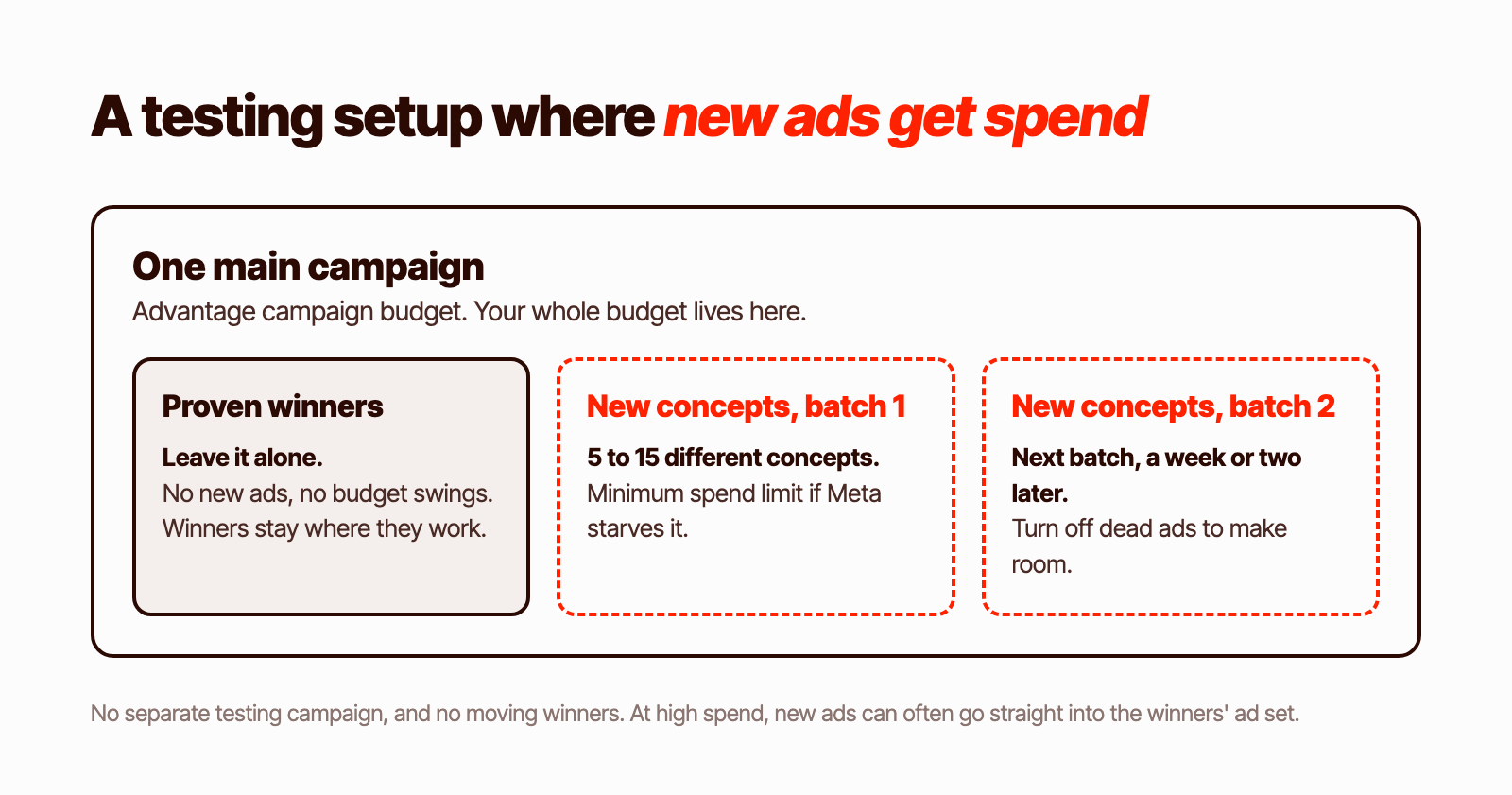
This does two things:
- New ads don't compete head-on with your winners. Inside an ad set, Meta chooses between ads. If a proven winner is in the same ad set, the new ads rarely get a look.
- Your winners stay undisturbed. You're not adding ads to the ad set that's working, so you're not shaking up its delivery.
At high spend, this matters less. An ad set spending $30,000 a day gets so many conversions that adding new ads barely moves it, and you can often launch straight into it. But if you're spending around $50,000 a month or less, keep new creative out of your winning ad set.
Step 3: Launch in Batches of Genuinely Different Concepts
How you launch matters as much as where.
- Launch in batches. A new ad set with 5 to 15 new concepts gives Meta real options to choose from. One new ad at a time doesn't, and it makes it hard to tell what's working.
- Make them actually different. Different formats, angles, hooks and people. If the batch is five versions of the same creator saying the same thing, Meta will treat it as roughly one ad and spend accordingly. See how many ads to put in each ad set and what creative diversity means on Meta.
- Make them different from your winners, too. A new ad that looks like your top performer is competing with it, not adding to the account.
- Launch on a schedule. A new batch every week or two keeps something fresh in the pipeline before your winners fade.
Step 4: Make Sure the New Ad Set Gets Budget
With Advantage campaign budget, Meta decides how much each ad set gets. Sometimes it still sends almost everything to the ad set with your winners. If your new ad set is getting starved:
- Set a minimum spend limit on the new ad set. With Advantage campaign budget, you can set daily or lifetime spend limits on individual ad sets. A modest minimum guarantees new concepts get enough spend for a real read, without moving the whole budget.
- Check your bid strategy. If you're on a tight cost cap, new ads may not be able to win auctions at all. Loosening the cap or using Highest Volume on the new ad set lets them deliver. Many accounts start on Highest Volume for exactly this reason.
- Don't spread the budget too thin. If you're spending a few thousand dollars a day, a batch of 30 new ads is too many. Fewer, stronger concepts each get a fair shot.
Keep the minimum modest. The point is to give new concepts a real chance, not to override Meta's judgment entirely. If you force a lot of spend onto ads Meta doesn't want to deliver, you'll usually just pay more for worse results.
Step 5: Give It Time Before You Judge
New ads need time and spend before the numbers mean anything.
- Don't judge on day one. Early delivery is noisy. Give a batch at least several days.
- Judge on spend, not just time. An ad that's spent a fraction of your target cost per purchase hasn't had a real test yet.
- Look at the right metrics. Hook rate and hold rate tell you whether people watched. Cost per purchase, first orders and subscribers tell you whether it worked. Our hook rate benchmarks found the ads that got the most spend didn't have higher hook rates than the rest.
- Leave the winners alone. When a new ad starts working in its ad set, don't move it. It's already in the main campaign, getting budget.
Step 6: Clean Up
Ads that have had a fair amount of time and still aren't getting spend are taking up room. Turn them off in batches, so the next round of new concepts has space.
In the accounts we have data for, about 1 in 4 creatives that spent during a month had stopped spending by its final week. That's normal. The live set turns over constantly, and the cleanup is part of keeping new creative flowing. More in how many ads to run on Meta.
When It's Not the Setup
If you've done all of this and new ads still don't get spend, look hard at the creative.
Meta is a hits business. In the accounts we see, a small share of ads does most of the work. In our data from 17 accounts spending $100K+ a month, the median account had 75 creatives live at once, but only 17 that each took at least 1% of three months of spend. Most new ads won't win, and Meta often figures that out quickly.
The question is whether the ads being ignored are genuinely different ideas or variations of what's already running. If every batch is new hooks on the same concept, Meta is right to keep spending on the original. The fix is new angles, new formats and new people, not a new account structure.
Signs it's a creative problem:
- Every batch looks like the last one.
- New ads look like your winners, just with a different headline or color.
- Only one format ever gets tested, like UGC every time, or statics every time.
- New concepts get spend when forced, but the results are worse than your winners.
A Quick Checklist
Before you launch your next batch, check that:
- Your budget is in one main campaign, with winners left where they are.
- New concepts go into their own ad set, separate from your winners.
- The batch has 5 to 15 concepts that are genuinely different from each other and from your winners.
- The new ad set has a minimum spend limit if Meta keeps starving it.
- Your cost cap isn't so tight that new ads can't deliver.
- You'll judge after enough time and spend, on purchases, not just clicks or hook rate.
- Dead ads get turned off in batches to make room.
- The next batch is already in production.
How We Help at Biddyco
Setup gets new ads a fair shot. What wins is the creative. Our creative agency for Meta ads makes UGC, motion, static and hybrid ads for brands spending $100K+ a month, with files every two to four weeks so there's always a new batch of genuinely different concepts to test.
We work across 100+ accounts spending $20M+ a month on Meta, so each batch starts from what's working across other accounts, not just yours. Book an intro call to talk through your account.
FAQ
Why are my new Meta ads not getting spend?
Usually because Meta already has ads it trusts. Proven winners have weeks of data, and new ads have none, so Meta keeps spending where it expects results. New ads that look like your winners, too many ads on a small budget and a tight cost cap make it worse.
How do I get Meta to spend on new creative?
Launch new concepts in their own ad set inside your main campaign, in batches of genuinely different ads. If that ad set still gets starved, set a minimum spend limit on it and make sure your cost cap isn't too tight.
Should I use a separate testing campaign on Meta?
We don't recommend it. Keep one main campaign and test in a separate ad set inside it. That keeps your budget together and avoids moving winners, which tends to hurt their performance.
How many new ads should I test at once?
For most accounts, 5 to 15 genuinely different concepts per batch. Fewer if your budget is small, so each one gets enough spend to show something.
How long should I wait before turning off a new Meta ad?
Give it several days and enough spend for a real read. An ad that has spent only a fraction of your target cost per purchase hasn't really been tested yet.
Is low spend on a new ad a bad sign?
Often, yes. Meta's early read is that the ad won't perform as well as what's already running, and it's frequently right. Rule out setup problems first. If genuinely different concepts still get ignored, the creative is usually the issue.