Key Takeaways
- Paid social media advertising means paying to show ads to people on social platforms like Facebook, Instagram, TikTok, YouTube, Pinterest and LinkedIn.
- Targeting matters less than it used to. On Meta and TikTok, the algorithm finds buyers, and your creative tells it who to look for. Broad targeting with strong, varied ads usually beats narrow audiences.
- The ads are the strategy. Statics, UGC, motion graphics and hybrids each reach different people. Running a mix gives the platform more ways to find buyers.
- Benchmarks from our data: the median Meta CPM was $18 across $35M in US spend, and the median hook rate on top-spending video ads was 21%.
- Start with one platform, usually Meta, and get it working before you spread your budget thin.
What Is Paid Social Media Advertising?
Paid social media advertising, or paid social, is any ad you pay to show on a social platform. You set a goal, a budget and an audience, and the platform shows your ad in feeds, stories, short-form video and other placements to people who don't already follow you.
It's how most direct-to-consumer, CPG and app brands find new customers. We make ads for 100+ accounts spending $20M+ a month on Meta, so the advice below comes from what we see working across them.
Paid Social vs. Organic Social
Organic social is what you post for free to your own followers. Paid social puts ads in front of people who've never heard of you.
| Organic social | Paid social | |
|---|---|---|
| Who sees it | Mostly your followers | Anyone the platform picks for your goal |
| Cost | Free to post | You pay for reach, usually per 1,000 impressions |
| Reach | Limited and unpredictable | Scales with budget |
| Measurement | Likes, comments, follows | Purchases, leads, cost per result, ROAS |
| Best for | Community and brand voice | Finding new customers and sales |
The two work together. Organic posts that do well often make good ads, and creators who post about your brand can run as partnership ads from their own handle.
Paid Social vs. Paid Search
Paid search shows ads to people searching for something, like "protein powder" on Google. It captures demand that already exists. Paid social shows ads to people who weren't looking, so it creates demand. That's why the creative matters so much more on social: it has to stop someone mid-scroll and make them care.
Where to Run Paid Social: The Main Platforms
| Platform | Best for | Main ad formats |
|---|---|---|
| Meta (Facebook, Instagram, Threads) | Almost every consumer brand. The biggest reach and the most mature buying tools | Images, video, carousels, Reels, Stories |
| TikTok | Younger audiences, impulse buys, creator-led brands | Short vertical video, Spark Ads, TikTok Shop |
| YouTube | Longer stories, search-adjacent intent, TV-like reach | Skippable in-stream, Shorts, CTV |
| Home, fashion, food and planning-heavy purchases | Images, video, carousels | |
| Snapchat | Gen Z and young millennials | Vertical video, AR lenses |
| B2B, recruiting, high-value services | Single image, document, video, lead forms | |
| Niche communities and research-heavy buyers | Image, video and conversation ads |
Where to start: for most consumer brands, Meta first. It has the widest reach and the most tested buying tools, and what you learn there (which angles, offers and formats work) carries over to TikTok and YouTube. Add a second platform once Meta is working, not before.
Paid Social Ad Formats, With Examples We Made
The format is one of the biggest levers you control. Different formats catch different people, so a healthy account runs several. Here are the main ones, with ads we've made for clients.
Static Image Ads
A single image with a headline. Statics are fast to make, easy to test and still pull their weight. In our static vs. video data, statics took about a third of spend in top-spending accounts, and cost per purchase came out within 4% of video's.
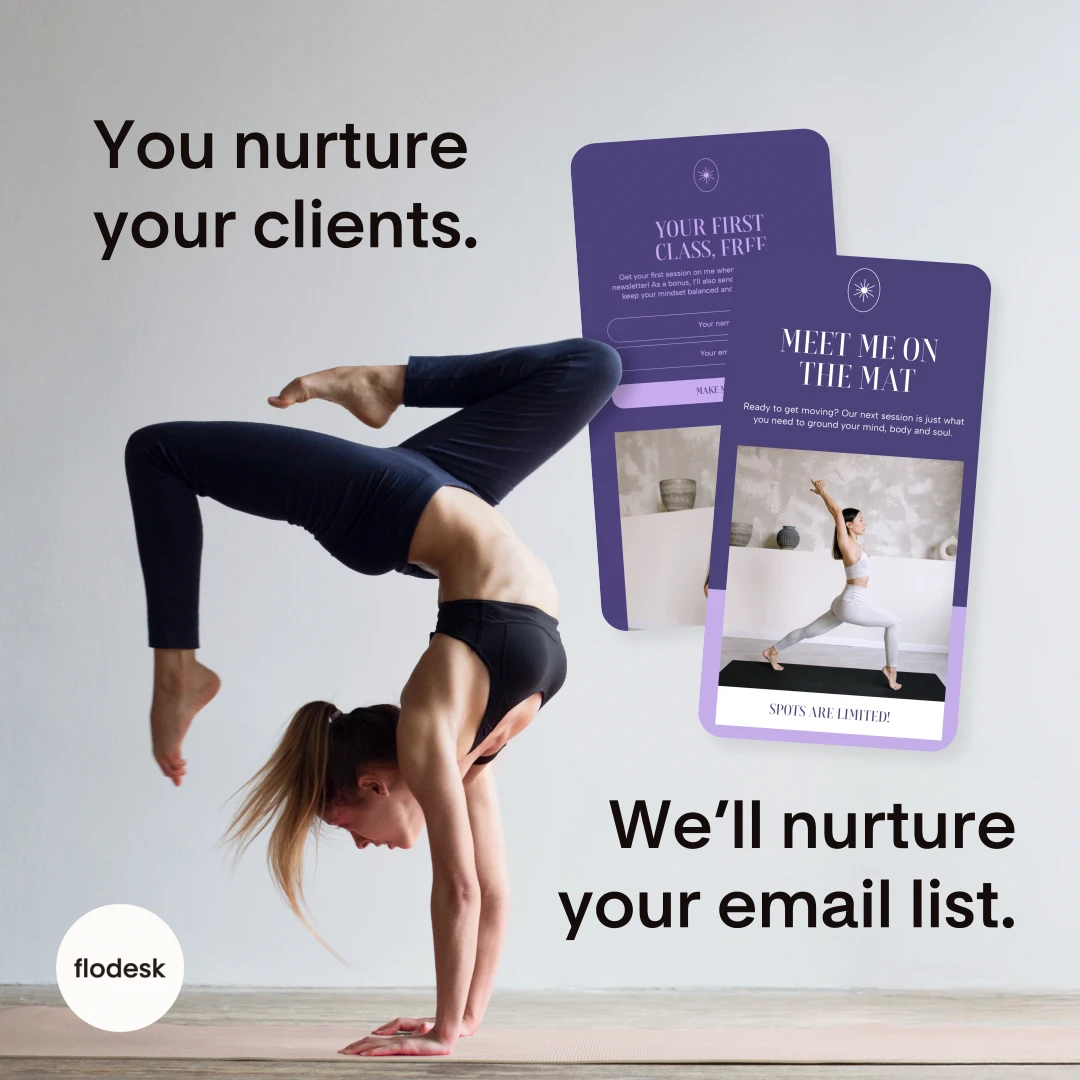
For Flodesk, an email design tool, the ad speaks to one specific customer: a fitness instructor. The line "You nurture your clients. We'll nurture your email list." sits next to a yoga handstand and two of the instructor's actual emails. A good static picks one person and one idea and makes both obvious at a glance. More in the ultimate guide to static ads.
UGC Video Ads
User-generated content, or UGC, is video made by real creators talking about a product in their own words. It looks native to the feed, which is why it works.
For Capitalize, a 401(k) rollover service, the creator walks through the product while getting ready for work. Retirement accounts are a dry subject. Giving the creator something to do with their hands keeps people watching long enough to hear the pitch. More in the ultimate guide to UGC ads.
Motion Graphics Ads
Animated ads built from product shots, type and design. Motion is great for explaining a product, showing a comparison or making proof move, and it doesn't need a shoot.
For Ballast, a slider wipes across the frame to reveal the product in different settings, first the beach and then a campsite. It borrows a before-and-after move people already know and uses it to show range instead. More in the ultimate guide to motion ads.
UGC and Motion Hybrids
Real creator footage with animation on top. The footage keeps it feeling native, and the motion explains what the camera can't capture.
For Guava, the creator stands between the Guava Roam jogging stroller and a competitor's, and makes the case for the Roam. Animated tags keep the two strollers straight, picture-in-picture clips prove each point as it comes up, and headline text builds the argument on screen. The creator makes it believable. The motion makes it easy to follow, even with the sound off. See 17 UGC hybrid ad examples.
Moving Stills
A static image with one or two animated elements. It runs as video in the feed, so it gives the platform a different kind of asset from the same design work.
For Avantera, a ring of benefits slowly rotates around the jar, so a new benefit comes into view every few seconds without cluttering the frame. More in GIF ads and moving stills.
Other formats worth knowing: carousels (several images or videos in one swipeable ad), collection and catalog ads for ecommerce, and lead form ads that collect contact details without leaving the app. For sizes, see our Meta ad specs.
How to Build a Paid Social Strategy
1. Pick One Goal and One Conversion Event
Decide what a win looks like, usually a purchase, a lead or an app install, and optimize for that event. Optimizing for clicks or engagement gets you clicks and engagement, not customers.
2. Start on One Platform
Spreading a small budget across four platforms means none of them gets enough data to learn. Meta says an ad set needs about 50 results in a week to exit the learning phase. Concentrate spend until one platform is working.
3. Keep the Account Structure Simple
Fewer campaigns and ad sets, each with more budget, learn faster than lots of small ones. One of the $1M+ a month accounts we broke down runs a single campaign with three ad sets. See how three $1M+ a month accounts are structured and testing vs. scaling campaigns.
4. Go Broad and Let the Creative Target
Since Meta's Andromeda update, the platform reads your ads to decide who to show them to. A video about busy parents finds busy parents. A static about gym recovery finds gym-goers. Broad targeting with genuinely different ads usually beats stacking interests on narrow audiences.
5. Make Enough Creative, and Make It Different
This is the step most accounts underinvest in. You need a steady flow of new ads, and they need to be genuinely different from each other: different people, angles, formats and hooks, not ten versions of one video. More in what creative diversity means on Meta and how many ads to run on Meta.
6. Mix Formats in the Same Ad Set
Put statics, UGC, motion and hybrids side by side and let the platform match each person with the format they respond to. Statics hold their own when they compete. Splitting formats into separate ad sets mostly slows learning.
7. Measure What Matters, Then Refresh
Judge ads on cost per purchase or lead and on return on ad spend, not likes or click-through rate. Use hook rate to spot weak openings. Then cut what isn't working, make more of what is, and keep new ads coming before the winners wear out.
Metrics and Benchmarks
| Metric | What it tells you | Benchmark from our data |
|---|---|---|
| CPM | Cost per 1,000 impressions | Median $18 on Meta across $35M in US spend, June to August 2026 (source) |
| Hook rate | Share of impressions that watch the first 3 seconds | Median 21% across 479 top-spending Meta video ads (source) |
| Hold rate | Share that keep watching | Median 4.6% in the same set |
| CPA | Cost per purchase or lead | Depends on price point and margin |
| ROAS | Revenue per dollar of ad spend | Depends on margin and repeat purchase rate |
One caution from our hook rate data: the ads Meta spent the most on didn't have higher hook or hold rates than the rest. Use hook rate to diagnose a weak opening, not to pick winners. For more numbers, see our Meta Ads Statistics hub.
To see how CPM, CTR, conversion rate and order value add up to your CPA and ROAS, try our ROAS calculator. Slide any number and watch the rest change.
How Much Does Paid Social Cost?
There's no minimum on most platforms, but there is a practical one. You need enough budget for each ad set to get about 50 conversions a week, so a brand with a $50 cost per purchase needs roughly $2,500 a week per ad set to give Meta the data it wants.
The other cost is creative. Ads wear out, and a growing account needs new ones every few weeks. Brands spending $100K+ a month on Meta usually need a steady supply of genuinely different ads. See what a creative agency for Meta ads costs if you're weighing outside help.
Common Paid Social Mistakes
- Running the same ad in ten versions. Small tweaks to one video don't count as new creative.
- Narrow targeting on a small budget. It starves the algorithm of data and raises costs.
- Judging ads too early. A new ad that doesn't get spend in its first days isn't necessarily a loser. See why new Meta ads don't get spend.
- Only one format. UGC-only or static-only accounts leave buyers on the table.
- Optimizing for the wrong thing. Clicks and likes are easy to get and hard to bank.
- Letting winners run until they die. Plan the next batch before you need it.
Doing Paid Social In-House vs. With an Agency
Plenty of brands run media buying in-house and bring in outside help for creative, because that's the part that's hardest to staff. A media buyer can manage budgets and campaigns, but a steady flow of new UGC, motion and static ads takes writers, editors, designers and creators. More in in-house vs. agency ad creative.
That's what Biddyco does. We're a creative agency for Meta ads with a US-based senior team, making UGC, motion, static and hybrid ads for brands spending $100K to $5M a month. New files land every 2 to 4 weeks, and we aim for one round of feedback. Book an intro call to talk through your account.
FAQ
What is paid social media advertising?
Paying to show ads on social platforms like Facebook, Instagram, TikTok, YouTube, Pinterest and LinkedIn. You set a goal, budget and audience, and the platform shows your ad to people most likely to take that action.
What is the difference between paid social and organic social?
Organic social is free content posted to your own followers. Paid social is ads you pay for, shown to people who don't follow you yet. Paid reaches new customers at scale, and organic builds community with the ones you have.
Which platform is best for paid social advertising?
For most consumer brands, Meta (Facebook and Instagram) is the best place to start because of its reach and buying tools. TikTok and YouTube are strong second channels. LinkedIn is usually best for B2B.
How much should I spend on paid social?
Enough for each ad set to get about 50 conversions a week, which is roughly 50 times your cost per conversion. Spend less than that and the platform has too little data to optimize well.
What is a good CPM for paid social?
In our data, the median Meta CPM was $18 across $35M in US ad spend from June to August 2026. CPMs vary by industry, season and audience, and climb in Q4. See Black Friday CPMs on Meta.
What type of paid social ad works best?
No single format wins everywhere. In our data, statics took about a third of spend and converted at about the same cost as video. The best accounts run a mix of statics, UGC, motion and hybrids so the platform can match each person with what they respond to.
What is a paid social strategy?
A plan for how you'll use paid ads on social to hit a goal: which platform, what you optimize for, how you structure campaigns, how much you spend and, most importantly, what ads you'll make and how often you'll refresh them.