Most SaaS brands don't have a budget problem on Meta. They have a creative problem. The money is there, the targeting is set up, and the account runs fine, but spend hits a ceiling. Push more budget in and results fall apart, so the account settles at a number that feels safe and stays there.
That's where Constant Contact was when we started working together. As a tech creative agency, we make paid social creative for software and app brands, and Constant Contact is one of the clearest examples of what the right creative can unlock for a SaaS company.
The Challenge: A Healthy Budget That Stopped Scaling
Constant Contact is email, SMS and social marketing software built for small businesses. When we came in, they had a healthy monthly ad budget on Meta, but the account had plateaued. It wasn't able to scale any further.
That's a common pattern for SaaS. The account relies on a small set of ads, usually product-focused and similar in style, and Meta runs out of new people to show them to. Adding budget just means showing the same ads to the same kind of person more often. The fix isn't a new audience setting. It's giving the algorithm genuinely different creative to work with, which is exactly what Meta's Andromeda update rewards.
The Results
Within a few months, Constant Contact's Meta spend had 4x'd.
Today, they're spending 3x more on Biddyco creative alone than they were spending in the entire Meta account before we started.
That's the real measure of good SaaS ad creative. Not a single winning ad, but an account that can take on much more budget because it has enough strong, varied creative to spend it on.
The Approach: Creative Diversity for a SaaS Product
The core of the work was feeding the account a diverse set of creative, instead of more versions of the same ad. We built three formats side by side:
- UGC. Real small business owners and creators talking about the product in their own words, often in very native, "day in the life" styles that look like something you'd see from a friend.
- Animation and motion. Polished SaaS demos and product motion that show the software working clearly and quickly.
- UGC and animation hybrids. Creator footage with motion layered on top: animated UI, callouts and on-screen stats that turn a talking head into a product story.
The range went from polished product demos at one end to completely native, lo-fi small business content at the other. That spread is what gave Meta room to find new buyers, and gave Constant Contact room to scale.
SaaS Ad Examples From Our Constant Contact Work
These four ads run from the most polished end of the mix to the most native.
1. The Polished SaaS Demo: "More Than Just Email"
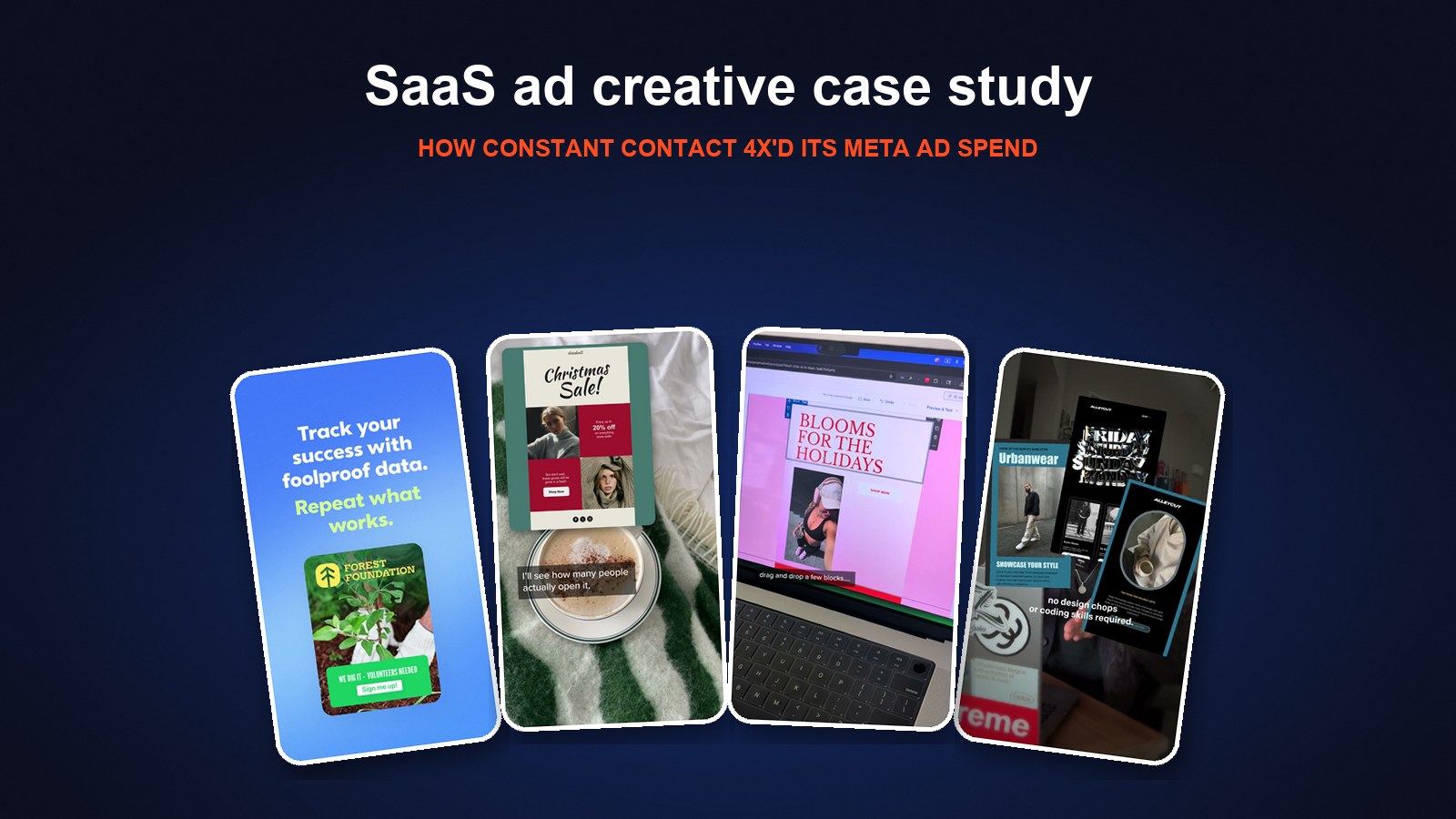
This is pure motion. It opens on a challenge to what the viewer thinks they know: "You think Constant Contact is just email marketing?" A phone rises into frame, the logos of the tools it connects with, like Instagram, Facebook, LinkedIn, Stripe and Salesforce, burst out around it, and the answer lands: "Think again." From there it walks through the product using a single example business, a nonprofit called Forest Foundation: "It's like having a marketing team on hand" over a social post and an SMS for Earth Day volunteers, a newsletter and a sign-up form built "in minutes," then a reporting dashboard with 1,700 emails sent and a 38% open rate under the line "Track your success with foolproof data. Repeat what works." It ends on "Try it FREE for 30 days."
Two things make this work for SaaS. It reframes the product in one line, which matters when people already have an opinion about your brand. And it shows the whole platform through one believable customer, so every screen feels connected instead of like a feature tour.
2. The Episodic Series: "Marketing Your Small Biz During the Holidays"
This hybrid is framed as episode three of a creator's series, "Marketing your small biz during the holidays." She's out on a busy holiday shopping street, talking about the power of seasonal newsletters, then we cut to her laptop as she builds a "Christmas Sale" email from Constant Contact's drag-and-drop templates. Motion takes over from there: the email animates into view, an open-rate stat ticks up to 30%, and the same email turns into a social post using Constant Contact's AI tools. She closes with "I'd be completely underwater this holiday if it weren't for Constant Contact."
Framing an ad as an episode borrows the feel of organic content, which makes it easy to watch. And the motion layer does something UGC alone can't: it shows the product working, with real numbers, in a few seconds.
3. The 10-Minute Challenge
This creator opens with a dare to the viewer: you think she can't build an email, social and SMS campaign in under 10 minutes? Then she does it on camera, choosing a template, dropping in her own photos, using the AI assistant to write copy, turning the email into a social post and setting up a text-to-join welcome message before scheduling it all.
For SaaS, a challenge is one of the best ways to demo a product without it feeling like a demo. The viewer is following a story with a clock on it, and by the end they've seen the whole product in action.
4. The Small Business Owner Testimonial
This is the most native of the four. A small business owner who runs a streetwear brand sits at his desk and opens with "I got myself the best gift, and it's definitely not what you'd expect." He talks about creating emails that drive revenue with no design or coding skills, and his own branded emails and Instagram posts pop up on screen as he goes.
For software sold to small businesses, the buyer and the user are the same person. Hearing another owner talk about their own business is often more convincing than any product shot, and it looks like the content small business owners already follow.
What This Means for SaaS Ad Creative
A few lessons from the Constant Contact work apply to almost any SaaS brand on Meta:
- A spend plateau is usually a creative plateau. If the account can't take more budget, look at how different your ads actually are before touching targeting.
- Mix polished and native on purpose. Polished demos build trust in the product. Native UGC builds trust in the people using it. You need both.
- Show the product, but through a person. Hybrids let a real creator carry the story while motion shows the UI and the results.
- Speak to the actual buyer. For small business software, that means real owners, real businesses and real moments from their day.
- Keep the pipeline full. Scaling spend means producing enough new, genuinely different creative to keep up with the budget.
We've broken down more of these approaches in how to advertise an app or SaaS product on Meta, and in our UGC hybrid ads post. For another example of this work at scale, see our Uber ad campaign examples.
Work With the Team Behind Constant Contact's Ads
The same in-house team that makes Constant Contact's creative makes UGC, motion and hybrid ads for SaaS, app and fintech brands spending $100K–$5M+/month on Meta.
If your SaaS account has stopped scaling, see how we work on our tech creative agency page.