Key Takeaways
- Supplement ads have to sell something you can't see working, to a skeptical buyer, under strict rules about what you can say.
- Claims come first. Talk about how the product supports the body, never that it treats or prevents a disease, and have evidence for anything you say.
- Since the results are invisible, show the routine, teach how it works and let proof do the convincing.
- The best proof is specific: research, third-party testing, nutrient counts with footnotes and real reviews.
- Every gummy and capsule looks the same. A distinctive look is one of the few real advantages you can build.
- Sell the habit, not one bottle. Supplements are a repeat purchase, so the ad should make it easy to start a routine.
Supplements might be the hardest thing to sell on Meta.
The product is a capsule, a gummy or a scoop of powder, so it looks like every other product in the category. The benefit is usually invisible and takes weeks to show up. The buyer has been burned by products that didn't work. And the rules about what you can say are stricter than almost any other consumer category.
It's also one of the categories we work in most. We've made supplement ads for brands like SmartyPants, ZBiotics, iHerb, Maximus, FlavCity and Awesome Aminos. This guide covers what we've learned, with real examples.
If you sell other consumer products too, our ultimate guide to making CPG Meta ad creative covers the broader playbook. This one is just about supplements.
What Makes Supplement Ads Different
- You can't show the result. A skincare ad can show glowing skin. A vitamin ad can't show a stronger immune system.
- Results take time. Most supplements work over weeks, not minutes, so there's no instant payoff to film.
- The buyer is skeptical. They're putting it in their body, or their kids' bodies, and they've seen plenty of overpromising.
- The rules are strict. The FDA, the FTC and Meta all have a say in what a supplement ad can claim.
- The category is crowded. Hundreds of brands sell nearly identical products with nearly identical promises.
- It's a repeat purchase. The money is in the second, third and tenth order, not the first.
Each of the steps below deals with one of these problems.
Step 1: Know What You Can Say
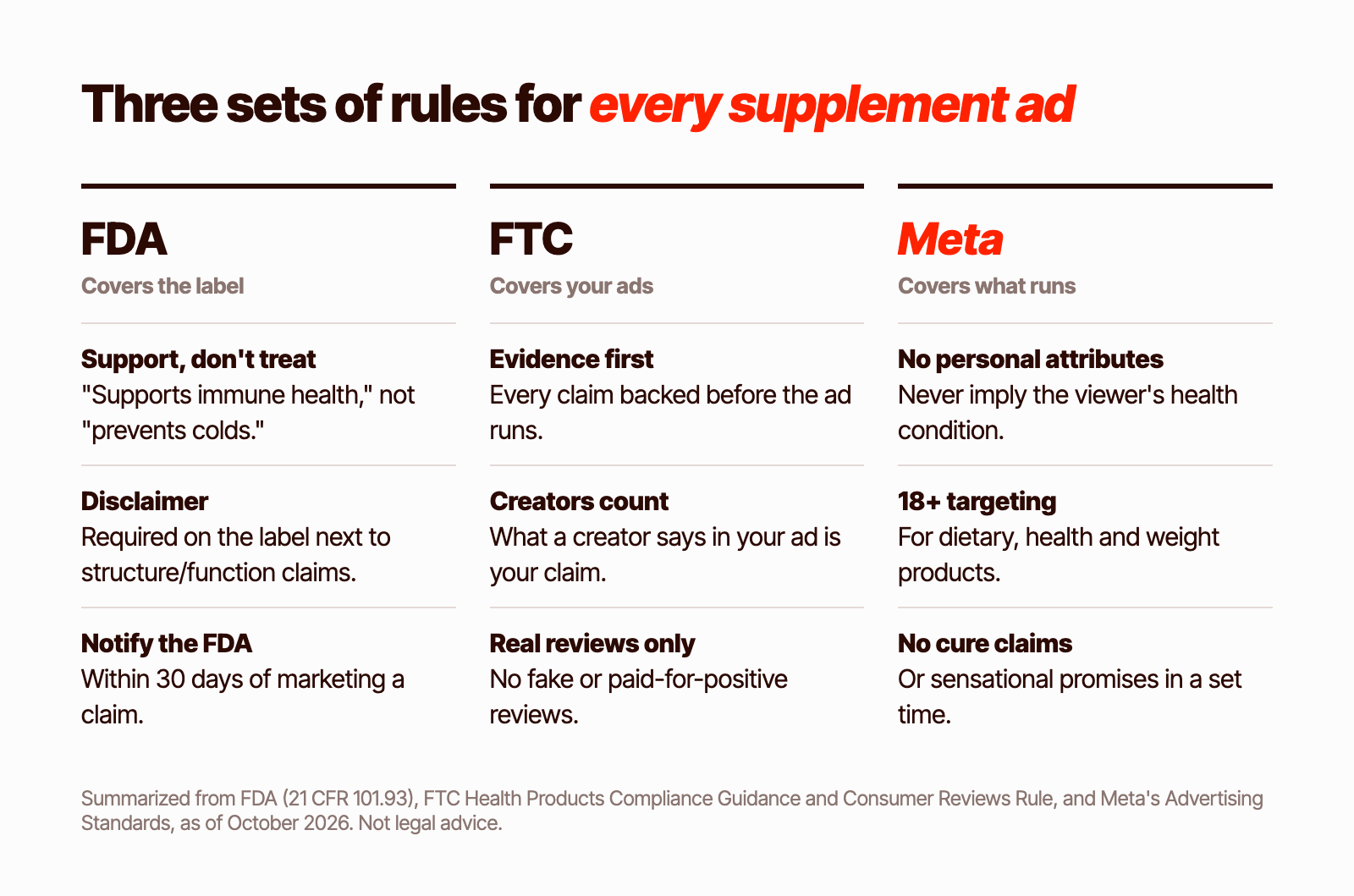
Start here, because a great ad that gets rejected or draws a warning letter isn't a great ad. Three sets of rules apply: the FDA's, the FTC's and Meta's. Here's how they work, in plain English. This isn't legal advice, so run your claims past your regulatory counsel.
The FDA: Support the Body, Don't Treat a Disease
Supplements can make structure/function claims. These describe how a nutrient or ingredient affects the body's structure or function. The FDA's own example is "calcium builds strong bones."
They can't make disease claims. A disease claim says, directly or by implication, that the product affects a specific disease or its typical symptoms. Make one, and the FDA treats the product as a drug.
| Say this | Not this |
|---|---|
| Supports immune health | Prevents colds and flu |
| Supports restful sleep | Treats insomnia |
| Supports healthy digestion | Relieves IBS |
| Supports focus | Helps with ADHD |
When a structure/function claim appears on a supplement's label, the label must carry this disclaimer:
"These statements have not been evaluated by the Food and Drug Administration. This product is not intended to diagnose, treat, cure, or prevent any disease."
That rule covers labels, not ads. Many brands carry the disclaimer into their ads anyway, linked to the claim with an asterisk, as SmartyPants does in the motion ad in Step 6. We'd recommend it. See the FDA's guidance on structure/function claims.
The FTC: Have the Evidence Before the Ad Runs
The FTC has primary responsibility for advertising, including your Meta ads. Its Health Products Compliance Guidance is clear on a few points:
- You need evidence before the ad runs, for every objective claim, whether you say it outright or just imply it.
- For health claims, the standard is "competent and reliable scientific evidence." The FTC says randomized, controlled human trials are generally what experts would require.
- Creators' claims are your claims. If a creator says something in your ad, you're responsible for it.
- "Results not typical" doesn't fix a misleading testimonial. If a testimonial shows results most people won't get, the ad needs to say what people can generally expect.
The FTC's rule on consumer reviews and testimonials, in effect since October 2024, also bans fake reviews, reviews from people who never used the product, and paying for reviews that have to be positive. Reviews from employees need a clear disclosure. Violations can cost up to $53,088 each.
This is being enforced. In July 2026, the FTC finalized an order against TruHeight, a maker of height supplements for kids, over unsupported claims and reviews from employees and people given free product for five-star reviews.
Meta: Don't Talk About the Viewer's Health
Meta's ad policies add their own rules on top:
- No personal attributes. Ads can't assert or imply something about the viewer's physical or mental health. Meta's own examples: "New diabetes treatment available" is allowed, "Do you have diabetes?" isn't. For a supplement, "Gut health support in one gummy" works. "Struggling with your gut?" doesn't. See Meta's personal attributes policy.
- 18+ targeting. Ads for dietary, health, weight loss and weight gain products must target people 18 or older. General food and protein products are exempt.
- Weight loss has extra rules. No negative self-perception, no close-ups pinching fat, and before-and-after images have to show how long the results took.
- No cure claims. Meta bans claims to cure conditions like diabetes, cancer or Alzheimer's, and sensational promises of specific results in a set time without qualifiers. See Meta's health and wellness policy.
- Some ingredients are off limits. Meta can reject ads for supplements it considers unsafe, at its own discretion.
One more thing for your media buyer: since September 2025, Meta flags custom conversions with names that suggest a health condition, like "arthritis" or "diabetes." Name events neutrally.
The good news is that the rules push you toward better ads anyway. "Supports restful sleep" with real proof behind it is more convincing than "cures insomnia" ever was.
Step 2: Show Where It Fits in a Day
You can't film a supplement working. You can film the moment someone takes it, and the life it's part of.
For ZBiotics, this ad follows a weekend: packing for the beach, taking a ZBiotics before drinks with friends, and ending on "Planning for great weekends leads to great Mondays." The product is a small part of the story, and that's the point. It shows when you'd use it and what the payoff feels like, without claiming more than the product does.
Routine ads work because they answer the practical questions a buyer has: when do I take it, how does it fit into my day, and what do I get out of it. They also make the habit feel easy, which matters for a product people need to take again and again.
Ideas for routine ads:
- The morning stack. Where the product sits next to coffee, breakfast or the gym bag.
- The before and after of a moment, not a body. Before the night out and the next morning. Before the workout and after.
- A day in the life of the person who'd actually buy it.
- The kids' version. For family products, the morning chaos and the one thing that's easy.
Step 3: Teach Something
Supplement buyers want to know how it works. An ad that teaches them something earns attention and builds trust at the same time.
For ZBiotics, this ad is a cocktail recipe. It opens on "the secret to a perfect Negroni Sbagliato, without the lousy next morning," then steps through the recipe while on-screen text explains what ZBiotics is and what it does, including a definition of acetaldehyde, the byproduct of alcohol it helps break down.
The recipe gives people a reason to watch. The education rides along with it.
Ways to teach in a supplement ad:
- Explain the mechanism in one simple line. What does the ingredient actually do?
- Define a word your buyer has heard but doesn't understand.
- Bust a myth about the category. Our CPG guide has a ZBiotics example built around one.
- Wrap it in something useful, like a recipe, a routine or a tip, so the lesson doesn't feel like a lecture.
Step 4: Prove It
When you can't show the result, proof does the work. Supplement buyers respond to evidence, and they can tell the difference between real proof and vague promises.
For Awesome Aminos, this motion ad opens on "Our brain power fades as we age," then flashes the research behind it, a page from a published study, before landing on "research shows EAAs boost." It follows with the numbers: 19+ vitamins, 55+ superfoods, 80+ verified nutrients.
For SmartyPants, this UGC and motion hybrid stacks proof across real parents and kids: over 15 different nutrients, 45% more nutrients with a footnote, a "verified clean formula" with the Clean Label Project award on screen, and no synthetic colors or artificial sweeteners.
Types of proof that work for supplements:
- Research. Show the study, not just "clinically proven." If you cite it, make sure it supports exactly what you're saying.
- Third-party testing and certifications. NSF, Clean Label Project, Informed Sport and similar seals carry weight because the brand didn't award them to itself.
- Specific numbers, with the footnote that explains them.
- What's not in it. For a skeptical buyer, "no synthetic colors" can matter as much as what is in it.
- Real reviews, which brings us to the next step.
For more ways to work proof into an ad, see 11 ways we build press and social proof into Meta ads.
Step 5: Borrow Proof Shoppers Already Trust
People trust Amazon reviews more than they trust your ad. So show them.
For SmartyPants, this ad is a walkthrough of the Amazon listing. It opens on the #1 Best Seller badge with "Wondering why SmartyPants is the #1 Best Seller on Amazon?", scrolls through the ingredients and certifications, the "45% more nutrients" comparison, real five-star reviews from parents, and the Subscribe & Save discount.
It works because none of the proof comes from the brand. A best seller badge, a star rating and a parent writing "my toddler asks for these every day" are things the buyer already knows how to read.
Other places to borrow trust from:
- Retail shelves. "Now at Target" tells people the product is established.
- Review counts and star ratings from wherever you sell the most.
- Comments on your own ads. Real questions and real replies from customers.
- Experts, like dietitians or doctors, when they genuinely use or recommend the product.
Whatever you show has to be real. Don't invent reviews, edit them to say something they didn't, or show results that aren't typical. More on that in Step 1.
Step 6: Make Your Product Look Different
Most supplement ads look the same: a bottle on a clean background, a few icons, "clean ingredients you can trust." If a viewer can't tell your ad from the last three they scrolled past, they won't remember whose it was.
For SmartyPants, this motion ad builds a whole look out of the product. Hand-drawn type, gummies on paper, cutout letters for each vitamin, "C and D3 for immune support," "K1 for bone health," "A for eye health," and a flavor list with fruit illustrations. Note the FDA disclaimer under each claim.
Ways to look different in a crowded category:
- Own a visual style and use it across ads, so people recognize you before they see the logo.
- Show the product itself, not just the bottle. The gummy, the powder, the color.
- Use your packaging. If it's distinctive, make it the hero.
- Use a different format than the category. If everyone else runs creator testimonials, a sharp motion ad stands out, and the reverse.
Step 7: Cast the Real Buyer
Supplements are personal. People want to see someone like them taking the product.
- Kids' vitamins: parents, and kids who actually like the taste. The SmartyPants hybrid above is cast almost entirely with real parents and kids.
- Sports nutrition: people who actually train.
- Healthy aging: people in that age group, not 25-year-old models.
- Gut health or hangover products: people in the moment the product is for.
Creators should sound like customers, not spokespeople. Let them talk in their own words, but keep product names, ingredients and claims exactly as approved. For more on working with creators, see the ultimate guide to making UGC ads.
Step 8: Sell the Habit, Not One Bottle
A supplement is only worth it if someone keeps taking it. The ad should make starting the habit easy.
- Lead with the subscription offer when you have one. The SmartyPants Amazon ad ends on Subscribe & Save.
- Make the first order low-risk with a trial size, a discount or a guarantee.
- Set expectations. If results take a few weeks, say so. People who expect that are more likely to stick around.
- Talk to existing customers too. Ads about flavors, bundles and routines help people reorder.
Step 9: Mix Formats and Test
No single format works for every supplement buyer. Some trust a creator, some respond to a clean motion ad, some just want the offer in a static. Meta's delivery system rewards real variety, so a mix of genuinely different ads will reach more people than ten versions of one. More on that in Meta Andromeda.
- UGC for routines, reviews and real people.
- Motion for ingredients, mechanisms and a distinctive look.
- Statics for offers, comparisons and quick tests of new angles.
- Hybrids that put proof on top of creator footage.
Test the big things first: the angle, the problem you lead with and the type of proof. Then test hooks and offers within what works. Judge ads on first orders and subscriptions, not just clicks. For benchmarks, see our Meta Ads Statistics hub.
Common Supplement Ad Mistakes
- Disease claims. "Cures," "treats" and "prevents" will get you in trouble with regulators and Meta.
- Calling out the viewer's health. "Struggling with anxiety?" breaks Meta's rules on personal attributes.
- "Clinically proven" with nothing behind it.
- Testimonials with results that aren't typical, shown without context.
- A bottle on a white background as the whole idea.
- Expecting instant results from a product that works over weeks.
- Selling one bottle when the business depends on the second order.
- Creators improvising claims that legal never approved.
A Quick Supplement Ad Checklist
Before a supplement ad goes live, check that:
- Every claim is about supporting the body, not treating or preventing a disease.
- You have evidence for every claim, and specific numbers have footnotes.
- Structure/function claims carry the FDA disclaimer, linked with an asterisk.
- The ad doesn't assert or imply anything about the viewer's health, and targets 18+.
- Reviews and testimonials are real, unedited in meaning and representative.
- Creators said product names, ingredients and claims exactly as approved.
- The ad shows when and how someone would take the product.
- There's real proof: research, testing, certifications, numbers or reviews.
- The look is distinctive enough that someone could tell it was yours.
- The offer makes it easy to start, and ideally to subscribe.
How We Make Supplement Ads at Biddyco
Supplements are one of our biggest categories. We've made ads for SmartyPants, ZBiotics, iHerb, Maximus, FlavCity and Awesome Aminos, and our CPG creative agency makes UGC, motion, hybrid and static ads for supplement, food, beverage and other consumer brands.
We work across 100+ accounts spending $20M+ a month on Meta, so the angles and formats we bring to a supplement brand start from what's working across the category, not guesswork. And we know the rules, so ads get written to be approved the first time.
Here's what SmartyPants told us:
"We've been super impressed by the creative. We've worked with others in the past, but Biddyco's whole process is just so seamless and efficient. Our brand awareness has steadily increased, and our ROAS has gone up 59% on paid social."
Alison McClaran, Senior Director, Brand Strategy & Innovation
And ZBiotics, where we helped scale spend 4x:
"Biddyco ads work. The majority of our ad spend is now on them. And it's no comparison, the work they're doing is so much cheaper, on brand and less time intensive for us than other options we've tried."
Anna Lamb, Marketing Manager
For a look at how one supplement brand used Meta ads to build a billion-dollar business, see our breakdown of how Grüns grew to a $1 billion exit. If you're comparing agencies, our buyer's guide to hiring a CPG creative agency covers what to ask. Or book an intro call to talk through your account.
FAQ
What claims can a supplement ad make?
Structure/function claims, which describe how a nutrient or ingredient supports the body, like "supports immune health." Supplement ads can't claim to diagnose, treat, cure or prevent a disease, and you need evidence for every claim before the ad runs.
Do supplement ads need the FDA disclaimer?
The FDA requires it on the label when there's a structure/function claim. The rule doesn't cover ads, but many brands include it in ads anyway, linked to the claim with an asterisk, and we'd recommend it.
What can't you say in a supplement ad on Meta?
You can't assert or imply something about the viewer's health, like "Struggling with anxiety?", claim to cure conditions like diabetes or cancer, or make sensational promises of specific results in a set time. Ads for dietary and health products also have to target people 18 or older.
Can supplement ads use before-and-after photos on Meta?
For weight loss supplements, Meta allows before-and-after images in ads targeted to people 18 or older if they show how long the results took. They can't use negative self-perception or close-ups of body areas. Testimonials also have to reflect what people can generally expect, under FTC rules.
How do you prove a supplement works in an ad?
Use specific proof: published research that supports exactly what you claim, third-party testing and certifications, specific numbers with footnotes, and real reviews. Show it, rather than saying "clinically proven."
What kind of supplement ads work best on Meta?
A mix. Routine ads show where the product fits in a day, education ads explain how it works, proof ads stack evidence, and borrowed proof like Amazon reviews builds trust. Testing UGC, motion, statics and hybrids gives Meta enough different creative to find buyers.
How do you make a supplement ad stand out?
Give it a distinctive look. Most supplement ads are a bottle on a clean background. Owning a visual style, showing the product itself and using a different format than the rest of the category all help people remember whose ad it was.