Key Takeaways
- AI UGC is cheap per video. It's often expensive per winning ad, because most AI videos never get meaningful spend.
- AI avatars tend to look alike, and on Meta, ads that look alike compete with each other instead of reaching new people.
- Viewers notice. Brands tell us about comments calling ads fake, and trust dropping with older and high-trust audiences.
- The rules are catching up. New York now requires ads to disclose AI "synthetic performers," TikTok requires AI labels, and the FTC says AI "customers" can't pass as real ones.
- AI is genuinely useful behind the scenes: research, scripting, variations and resizing. The person on camera is where it tends to backfire.
A year ago, the pitch was everywhere. Why pay creators when an AI avatar can read your script? Make 100 UGC ads for the cost of five. Test everything.
A lot of brands tried it. On our intro calls this year, many of them told us how it went.
The stories are similar. An agency or a tool delivered a huge batch of AI UGC videos. Meta spent almost nothing on most of them. A few got called out in the comments. One prospect told us they were sick of AI face swaps with extra fingers. Another, an app advertiser, said the low price per video was deceiving, because so few of the ads ever got spend that the real cost per useful creative was far higher.
This post covers why AI UGC tends to disappoint, the new rules around it, and where AI actually earns its place in ad creative.
What We Mean by AI UGC
"AI UGC" usually means one of two things:
- AI avatars: a generated "person" talking to camera about the product, often from tools that turn a script into a video.
- Face swaps and digital replicas: a real creator's likeness or voice cloned and reused.
Both try to look like a real customer talking about a real product. That's the source of both the appeal and the problems.
Why AI UGC Disappoints
Cheap Per Video, Expensive Per Winner
The number that matters isn't cost per ad. It's cost per ad that actually scales.
On Meta, a small share of ads does most of the work. In our data from 17 accounts spending $100K+ a month, the median account had 75 creatives live, but only 17 that each took at least 1% of three months of spend. Most ads don't win, no matter who makes them.
So the question is hit rate. If a batch of 100 cheap AI videos produces no winners, it costs more than 10 well-made ads that produce one. The brands we talk to rarely describe AI batches producing many winners.
They All Look the Same
AI avatar tools draw from similar faces, similar settings, similar delivery. Your AI ads also look a lot like your competitors' AI ads.
That matters more than ever on Meta. Since the Andromeda update, ads that look and sound alike get grouped together and compete for the same people. A hundred AI videos with the same synthetic feel can count as only a handful of real concepts. We covered this in Meta Andromeda and creative diversity.
People Can Tell
UGC works because it feels like a real person's honest take. When viewers suspect the person isn't real, the whole point of the format is gone.
Brands describe comments calling ads fake, and trust dropping, especially with older audiences and in categories where trust is the sale: health, supplements, finance, products for kids. A pet food brand told us AI creative made customers trust them less.
The research points the same way. In a January 2026 IAB study, 82% of ad executives believed young consumers felt positive about AI ads, but only 45% of those consumers actually did. The people making AI ads like them a lot more than the people watching them.
Some Categories Can't Afford It
If you sell something people put in their body, use on their kids or trust with their money, a fake-looking testimonial isn't a small risk. We wrote about why trust matters so much in categories like supplements in the ultimate guide to making supplement ads.
The Rules Are Catching Up
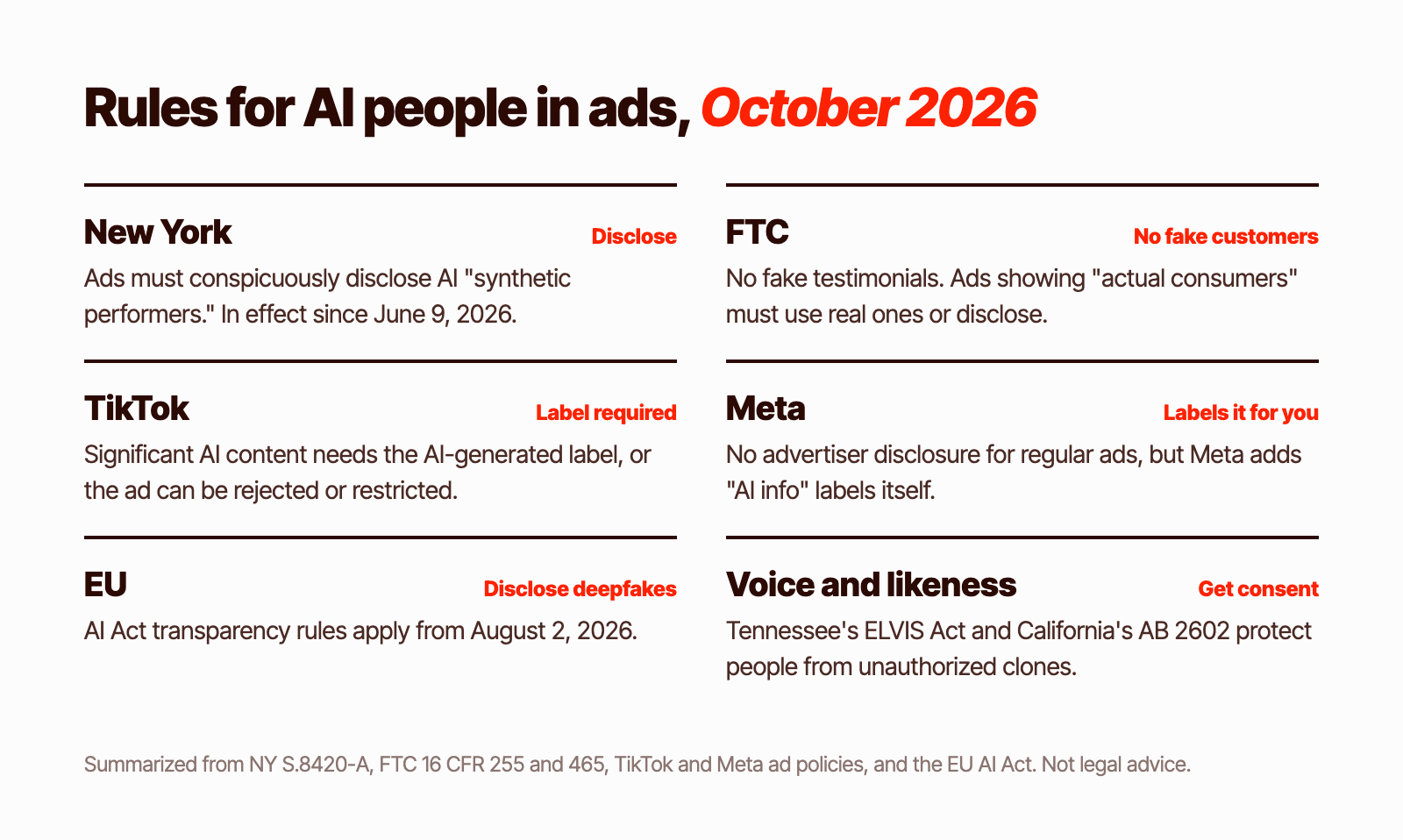
This is changing fast, and it varies by place and platform. Here's where things stand as of October 2026. This isn't legal advice, so check with your counsel before running AI people in ads.
New York: Disclose Synthetic Performers
New York passed a law in December 2025, S.8420-A, that took effect on June 9, 2026. Anyone producing a commercial ad must "conspicuously disclose" when the ad includes a synthetic performer, if they know it does.
A synthetic performer is a digitally created asset meant to look like a human performer who isn't any identifiable real person. In plain English: an AI avatar.
- It applies to visual and audiovisual ads. Audio-only ads are exempt, and so is AI used only to translate a real performer.
- Penalties are $1,000 for a first violation and $5,000 after that.
- It doesn't cover clones of real people. Using a real creator's face or voice is a consent issue, covered by other laws below.
The FTC: AI "Customers" Can't Pass as Real Ones
The FTC hasn't banned AI avatars. Its own guidance on the reviews rule says there's "no blanket prohibition on the use of AI-generated avatars in marketing." But two rules matter a lot for AI UGC:
- Fake testimonials are banned. The FTC's rule on consumer reviews and testimonials, in effect since October 2024, bans testimonials from people who don't exist or never used the product. The FTC specifically named AI-generated fake reviews.
- Fake customers need a disclosure. Under the FTC's Endorsement Guides, ads that present "actual consumers" should use actual consumers, or clearly disclose that the people aren't. An AI avatar saying "I've been using this for three months" is presenting itself as a customer.
The FTC has also said it will keep going after people who use AI to deceive consumers. The line is deception, not the tool.
TikTok: Label It
TikTok's ad policy requires the AI-generated content label, or your own clear disclaimer, on ads with significant AI content, including fully AI-generated media and AI voice clones. Undisclosed AI content gets ads rejected or restricted. TikTok also bans using a person's likeness without their consent.
Meta: Labels Itself
Meta doesn't require advertisers to disclose AI in regular ads, but it labels them itself. Ads made or significantly edited with AI can get an "AI info" label. Meta has also said that photorealistic AI people made with its own tools get a label right next to "Sponsored," and that it's detecting ads made with third-party AI tools. So even where disclosure isn't required, viewers may be told anyway.
Political and social issue ads are stricter: advertisers must disclose realistic AI people or altered media.
Voice and Likeness: Get Consent
Cloning a real person's voice or face brings its own rules:
- Tennessee's ELVIS Act makes it illegal to use someone's voice, including a simulated one, to advertise products without their consent.
- California's AB 2602 makes contract terms that let a digital replica of a performer replace their work unenforceable unless the intended uses are reasonably specific and the performer had a lawyer or union representation.
If you're cloning a creator, get clear, written consent that covers exactly how the clone will be used.
The EU: Disclose Deepfakes
If you advertise in Europe, the EU AI Act's transparency rules apply from August 2, 2026, including disclosure of AI-generated content that could falsely appear authentic.
What This Means in Practice
Put together, an AI avatar pretending to be a happy customer is now the riskiest version of AI UGC. In New York, it needs a disclosure. Under FTC rules, it needs to not pass as a real customer. On TikTok, it needs a label. On Meta, it may get one anyway.
And once an ad says "this person is AI-generated," it stops working as UGC. The format depends on viewers believing the person is real.
Where AI Actually Helps
None of this means AI has no place in ad creative. It's very good at the parts viewers never see:
- Research. Mining reviews, comments and support tickets for the exact words customers use.
- Scripting and briefing. First drafts of hooks, angles and creator briefs that a strategist then sharpens.
- Variations. New hooks, headlines and cuts of an ad that's already working.
- Production help. Resizing, captions, cleanup, translation and background work.
- Graphics and motion elements in ads that don't pretend to be a real person.
The pattern: use AI to make better ads faster. Don't use it to fake the thing that makes UGC work.
How to Use AI in Ads Without the Downside
- Keep real people in UGC. If the ad's power comes from a person's honest take, use a real person who actually used the product.
- Disclose when a person is synthetic. Required in New York and on TikTok, and the honest default everywhere else.
- Never let AI play a customer. No AI testimonials, no AI "I've been using this for months."
- Get written consent for any clone of a real creator's face or voice, covering exactly how it will be used.
- Judge AI ads on spend and results, not cost per video. Compare cost per winning ad.
- Watch the comments. If people are calling an ad fake, the ad is costing you more than it's making.
- Use AI behind the scenes, where it speeds up research, scripting and versioning.
Real Creators, Real Product
Here's what real UGC looks like. For SmartyPants, a real mom talks about why her kids actually ask for their vitamins, with her daughter in the ad.
For ZBiotics, a real creator walks through his weekend plans and why he takes ZBiotics the night before.
Nothing in either ad needs an AI disclosure, because the people in them are real.
How We Make UGC at Biddyco
We don't use AI UGC. Every person in our UGC ads is a real creator.
Our UGC ad agency makes premium UGC that doesn't feel fake. We source real creators, ship them the product, coach them and edit the footage into ads, along with UGC and motion hybrids, motion and statics, so your account has real creative diversity.
We work across 100+ accounts spending $20M+ a month on Meta, and files land every two to four weeks. If you've tried AI UGC and want to compare, see our creative agency for Meta ads or book an intro call.
FAQ
Do AI UGC ads work?
Some do, but most brands we talk to found that few AI UGC videos ever got meaningful spend. They're cheap per video but often expensive per winning ad, and they tend to look alike, which hurts on Meta, where similar ads compete with each other.
Are AI avatars legal in ads?
Yes, but with conditions. New York requires ads to disclose AI "synthetic performers" as of June 2026. The FTC bans fake testimonials and says ads presenting real customers must use real ones or disclose that they aren't. TikTok requires AI content to be labeled.
Do you have to disclose AI in Meta ads?
For regular ads, Meta doesn't require advertisers to disclose AI, but it labels AI-generated and AI-edited ads itself in many cases. Political and social issue ads must disclose realistic AI content. State laws like New York's can still require a disclosure.
What is New York's synthetic performer law?
A law that took effect June 9, 2026, requiring anyone producing a commercial ad to conspicuously disclose when it includes a synthetic performer, meaning an AI-generated person who isn't an identifiable real person. Audio-only ads are exempt. Penalties are $1,000 for a first violation and $5,000 after that.
Can I use AI to clone a creator's voice or face?
Only with clear consent. Laws like Tennessee's ELVIS Act protect a person's voice from unauthorized use in ads, and California limits contracts that let digital replicas replace performers. TikTok also bans using someone's likeness without consent.
How should brands use AI in ad creative?
Behind the scenes: research, scripting, briefs, variations of winning ads, resizing and captions. Keep real people in UGC, disclose synthetic people, and never use AI to play a customer.