Key Takeaways
- An in-house creative team isn't one designer. Making ads that scale takes strategy, copy, production, creator sourcing and project management.
- In-house teams know the brand best, but they only see their own account's data. An agency sees what's working across many accounts.
- Internal designers usually get pulled into other work: email, the website, packaging, sales decks. Ads are rarely their only job.
- Agencies get you a full team on day one, but they need time to learn your brand, and quality varies a lot from one to the next.
- For many brands, the best answer is a hybrid: keep brand ownership and quick edits in-house, and use an agency for new concepts and volume.
Every brand spending real money on Meta ends up asking the same question: should we build this ourselves or hire someone?
It usually comes up at a predictable moment. Creative has become the bottleneck. The same few ads are carrying the account, performance is slipping as they fatigue, and the team can't make new ones fast enough.
The instinct is to hire a designer. Sometimes that's the right call. Often it isn't, because the job is bigger than it looks.
We're an agency, so take our view with that in mind. But we've also worked alongside a lot of in-house teams, and in-house is the right answer for some brands. Here's how we'd think about it.
The Short Version
| In-house team | Agency | |
|---|---|---|
| Team | You hire, manage and keep every role | Full team from day one |
| Brand knowledge | Deep, from day one | Has to be learned |
| Performance data | Your account only | Patterns across many accounts |
| Focus | Often pulled into other projects | Ads are the whole job |
| Speed on small edits | Fast, same building | Slower, goes through a process |
| Range of formats | Limited to the skills you hire | Wider, if the agency is good |
| Cost | Salaries, benefits, tools and creators, fixed | Monthly retainer, easier to change |
| Scaling up or down | Hiring or layoffs | Change the scope |
What "In-House" Actually Means
When brands say they're going to bring creative in-house, they usually mean they're going to hire a designer or a video editor.
That's one role. Making Meta ads that keep an account growing takes several:
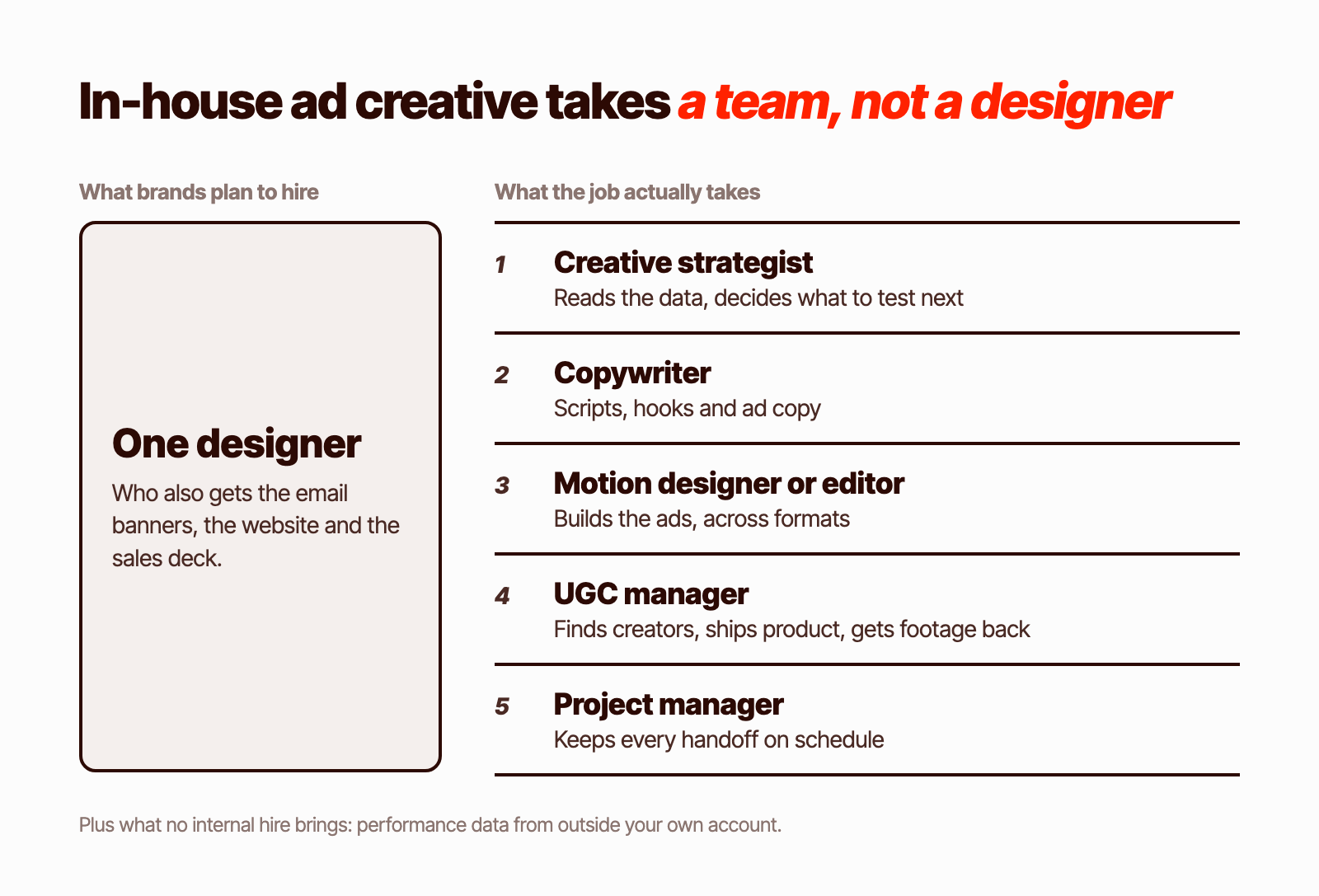
- A creative strategist who reads the account data and decides what to test next.
- A copywriter who writes the scripts, hooks and ad copy.
- A motion designer or editor who builds the ads.
- A UGC manager who finds creators, ships product and gets footage back on time.
- A project manager who keeps all of it moving.
These are different jobs. A great editor isn't necessarily a great strategist, and neither of them wants to spend their week chasing creators for raw footage. When one person covers all of it, output slows down and the account ends up recycling the same few ideas. We broke this down in more detail in the five roles behind a Meta ad creative team.
So the real comparison isn't "an agency vs. a designer." It's "an agency vs. hiring, managing and keeping a five-person team."
The Pros of an In-House Creative Team
In-house has real advantages, and for some brands they win.
You Know the Brand Better Than Anyone
An in-house team lives with the product, the customers and the brand every day. They know which claims legal will flag, which product features customers actually care about and what the founder will never approve. An agency has to learn all of that.
Small Changes Are Fast
Need a new price on a static, a swapped headline or a holiday version of last month's winner? An in-house designer can turn that around the same day, without a brief or a ticket.
You Own Everything
The people, the process and everything they learn stay with the company. Nobody leaves at the end of a contract with what they learned about your customers.
It Can Make Sense at Very Large Scale
Brands spending millions a month on Meta need a lot of creative, all the time. At that size, a full internal team can be cost-effective, and some of the biggest advertisers build one. Even then, they often still bring in outside partners, for the reasons below.
The Cons of an In-House Creative Team
You Need a Whole Team, Not a Designer
This is the big one. One designer can make ads. They can't also run strategy, write every script, source creators and manage the schedule. To do this well in-house, you need to hire, manage and keep several people with different skills, plus the tools, the creator budget and someone senior enough to lead them.
That's a real commitment, and it's slow. Hiring each role takes time, and the team takes time to gel before the output is consistent.
You Only See Your Own Data
An in-house team learns from one account: yours. They know what worked last quarter, but they don't see what's starting to work for other brands right now, or what's quietly stopped working everywhere.
An agency working across many accounts sees those patterns early. A new hook style that's lifting results across five brands, a format that's fading, a type of offer that's suddenly converting. That outside view is hard to build internally, because you'd need other brands' data to get it.
Designers Get Pulled Into Everything Else
This one is almost universal. The in-house designer was hired to make ads, but then the email team needs a banner, the website needs a refresh, the trade show needs a booth and the CEO needs a deck by Thursday.
Every one of those requests is reasonable. Together, they mean ad creative becomes the thing that gets done when there's time left over, which is never. Output drops right when the account needs new ads the most.
Creative Gets Stuck in a Style
A small team makes what it's good at. If you hired a great static designer, you'll get great statics. You probably won't get UGC, motion graphics, GIFs and hybrids at the same level.
That matters more now than it used to. Meta's delivery system rewards real creative diversity: different angles, formats and people, not variations on one look. More on that in our posts on Meta Andromeda and creative diversity.
The Cost Is Fixed
Salaries and benefits don't flex with your ad budget. If spend drops for a quarter, the team still costs the same. If you need to double output for a launch, you're hiring again.
Turnover Hurts
When a key person leaves, a lot of what they knew leaves with them, and you're back to hiring and training.
The Pros of an Agency
A Full Team on Day One
Strategy, scripting, creator sourcing, editing, motion and project management, without hiring any of it. A good agency is already set up to run the whole process.
Data From Outside Your Account
This is the biggest advantage, and the one that's hardest to copy in-house. An agency working with many brands sees what's working across accounts and can bring those ideas to yours before you'd have found them yourself.
Ads Are the Whole Job
Nobody at the agency gets pulled onto the website redesign. The team's only job is your ad creative, and it ships on a fixed schedule.
More Range
A good agency can make UGC, motion, static, GIF and hybrid ads, which is hard for a small internal team to match. That range is what gives Meta enough different creative to find new buyers.
Easier to Scale
Need more creative for a launch, or less for a slow quarter? Change the scope, not the headcount.
The Cons of an Agency
They Have to Learn Your Brand
The first month or two with any agency involves a learning curve. Good agencies shorten it with a thorough onboarding, but they'll never know the brand quite like the people who built it.
Less Speed on Small Requests
Agencies work in cycles: brief, concept, production, feedback, delivery. That's good for new concepts. It's slower for "can you change this one word by tonight."
Quality Varies a Lot
Some agencies are really execution shops. You still bring the ideas, and they build what you ask for. Others are strong at one format and stretch it across everything. It's worth knowing exactly what you're getting before you sign. Our post on what to look for when hiring a creative agency covers the questions to ask.
It's a Real Line Item
A good specialist agency usually starts around $10,000 a month for brands spending $100K+ on Meta. That's real money, though it's often less than the cost of the team it replaces. We broke down pricing in how much a creative agency costs.
You're Sharing Them
An agency has other clients. The good ones manage that well, but your account won't get 100% of anyone's attention the way an internal hire's would.
The Hybrid Model
For a lot of brands, the answer isn't one or the other.
A setup we see work well:
- In-house: a brand or growth lead who owns the creative direction, plus a designer for quick edits, resizes, offer updates and everything outside of ads.
- Agency: strategy, new concepts, UGC and motion production, and a steady supply of genuinely different ads.
The in-house team keeps the brand knowledge and the speed on small things. The agency brings the full team, the outside data and the range. And the internal designer can take the website requests without ad output falling behind.
Which One Is Right for You?
A few questions to work through:
- How much are you spending on Meta? Under about $100,000 a month, an agency retainer is a big share of the budget, and a freelancer or a strong generalist hire may make more sense. Above that, creative usually becomes the main thing holding back growth.
- Can you hire and manage a full creative team? Not one designer. Strategy, copy, production, creators and project management.
- Will the team only make ads? Be honest about how many other requests will land on them.
- Where will new ideas come from? If the answer is only your own account's history, you'll miss what's working elsewhere.
- How many formats do you need? If you need UGC, motion and static at the same time, count the skills that takes.
- How fast do you need to start? An agency can start in weeks. A full team takes months to hire.
If you have the budget and the leadership to build a full team that only makes ads, in-house can work well. If not, an agency, or a hybrid, usually gets you further faster.
How We Work With Brands at Biddyco
We're a creative agency for Meta ads for brands spending $100K+ a month. Our U.S.-based senior team handles strategy, scripting, creator sourcing, editing and motion, and makes UGC, motion and static ads. We work across 100+ accounts spending $20M+ a month, so the patterns we see in one account inform the ideas we bring to the next.
A lot of our clients have in-house designers making ads too. They lean on us for new ideas from outside their own account, and for the types of creative they can't make internally. Files land every two to four weeks, and we aim for one round of feedback.
If you're weighing your options, book an intro call and we'll talk through what makes sense for your account, even if the answer is building in-house.
FAQ
Is it cheaper to do ad creative in-house or with an agency?
It depends on what you'd hire. One designer is cheaper than an agency. A full team with strategy, copy, production, creator sourcing and project management usually isn't, once you add salaries, benefits, tools and creator fees. A good specialist agency usually starts around $10,000 a month.
What are the downsides of an in-house creative team?
You need to hire and manage several roles, not just a designer. The team only sees your own account's data, the cost is fixed, and internal designers often get pulled into email, web and other projects, so ad output slows down.
What are the downsides of a creative agency?
An agency has to learn your brand, small last-minute changes take longer, quality varies a lot between agencies, and you're sharing the team with other clients.
What does an in-house ad creative team need?
At minimum, a creative strategist, a copywriter, a motion designer or editor, a UGC manager and a project manager. Some brands combine roles, but each one is a different skill.
Can you use an in-house team and an agency together?
Yes, and many brands do. A common split is in-house for brand ownership, quick edits and non-ad work, and an agency for strategy, new concepts and production.
When should a brand hire a creative agency instead of building in-house?
When creative has become the bottleneck, you need several formats at once, you want ideas from outside your own account, or you can't hire and manage a full team quickly. Brands spending around $100,000 a month or more on Meta are usually at that point.